Showing posts with label Evelyn Waugh. Show all posts

Sunday, September 9, 2012

Book Review: Fairy Tale (1996) by Alice Thomas Ellis

Graham Greene once said that "every writer has a splinter of ice in his heart." I thought of this when I was reading Fairy Tale, a strange and sharply-written novel about a group of Londoners encountering fairies in rural Wales. These aren't, however, the kind of fairies who flit about in the moonlight playing merry pranks on maids and shepherds. These fairies eat people. But this isn't a full-on fantasy story; the fairies are mostly symbolic of some hard truths the human characters must deal with.

The four characters in the novel are Eloise, Sam, Clare and Miriam. Eloise and Sam are a somewhat New Age couple who've decamped from London to live the rural life in Wales. Both are from upper middle-class backgrounds. Sam works as a handyman, while Eloise sews exquisite clothes that are sold in a local upmarket store. Clare, Eloise's mother, lives in London. She's divorced, apparently living comfortably on her alimony, and desperately hoping to find another man. She seems to spend most of her spare time dining and drinking with her best friend Miriam. Clare begins to suspect that something is not quite right with Eloise and asks Miriam to go to Wales to check up on things. Miriam goes to the idyllic red cottage Eloise and Simon live in and finds that strange things are going on. Four peculiar men keep turning up at the cottage to ask odd questions, Eloise is acting broody and disappearing for long stretches of time, and there's something not quite right about the whole area. Clare travels down from London and it slowly emerges that the local fairy folk want Eloise to act as some kind of surrogate mother for a fairy child.

A plot description doesn't really do this novel justice. It's too easy to make it sound cute or silly. This is first of all an unsparing portrait of the emotional and spiritual lives of the four main characters. This is where the quote from Graham Greene comes into play. Alice Thomas Ellis is absolutely merciless with her characters. Their fears, their shallowness, their uncertainty about how to live their lives is put on display like meat in a butcher's window. The author's ruthlessness with her characters is reminiscent of the way Evelyn Waugh handled his characters. I looked up Ellis' bio online and found that, like Waugh and Greene, she was a Catholic, and a hardcore one at that. Mel Gibson hardcore. It leaves me wondering if a feature of English Catholic writers is a determination to see the worst in every character. Something to do with original sin? I don't know enough about Catholicism to say one way or another, but Ellis clearly had that "sliver of ice" in her heart that's needed to coldly examine all aspects of a character.

Ellis may have been a more-Catholic-than-the-Pope Catholic, but she keeps her religious beliefs on a short leash. There's definitely a religious aspect to this novel, but it's never shouted out. The lesson that seems to be on offer is that our modern, self-obsessed lives and faddish beliefs blind us to the older, deeper and more dangerous mysteries. The cuckoo in the Catholic nest here is Miriam, who is Jewish. She plays a key role in the climax of the story and it would seem that Ellis is suggesting, on a symbolic level, that Jews should embrace Christ. I may well be misreading this part of the novel, but why else does Ellis make a point of having a Jew as one of her characters?

Take away the religious aspects and this is still a fine, creepy novel. Ellis is a deft and clever writer, and her handling of the supernatural elements is excellent; it makes you wish she'd tried her hand at a more traditional fantasy or horror novel. 

Monday, July 30, 2012

Book Review: School for Love (1951) by Olivia Manning

Ever read a perfect novel? One in which the similes and metaphors are all pitch perfect, not a single word or sentence is out of place or redundant, the characters are fully-formed and resonate in the real world, and the novel is neither too long or too short? School for Love is such a novel. This isn't to say that it's one of the world's great books, but if it's not in the Champions League of novels, it's definitely well up in the First Division.

The setting is Jerusalem in 1945, just after the end of the war, and a young orphan named Felix has temporarily come to stay with Miss Bohun, a distant relative, before shipping back to England. Also boarding in the house is Mrs Ellis, a young and pregnant war widow. Bohun is the leader of the Ever-Readies, a small Christian sect with a fundamentalist bent. Felix, like any polite, well-brought-up middle-class boy, assumes Bohun will always act in a well-meaning and honourable fashion. He's sadly disillusioned. In the weeks that Felix and Ellis spend with Bohun while waiting for a ship back to England, she doesn't miss a chance to make their lives just a little bit more miserable, not to mention trying to line her pockets at their expense.

Bohun is one of the great, yet petty, monsters of modern fiction. Manning shows that Bohun's holier-than-thou moralizing is, like patriotism, the last refuge of scoundrels. This is not a wildly eventful or dramatic novel, but it shows how tyrants like Hitler and Stalin can also come in more innocuous packages. Bohun is a narcissist, and her self-love stems from her belief that her adherence to Jesus makes her immune from committing the smaller sins. She's parsimonious, mendacious, vindictive, petty, vengeful, not averse to a minor swindle or two, and has a profound lack of empathy. Bohun sees her faith as a trump card to be played on any occasion when her honesty or ethics are called into question by others or even by herself. She's a personality most of us have met or worked with, and the ranks of evangelical Christians in the U.S. are absolutely stiff with this type of person. 

Mrs Ellis is pretty much Bohun's opposite. She's been badly treated by the war but hasn't allowed that to make her bitter or vicious. But she's not a saint. She befriends Felix, who falls slightly in love with her, and eventually loses patience with his dog-like affection and hurts his feelings. At least Ellis is aware that she's hurt Felix. For Felix, his sojourn at Bohun's is a coming-of-age experience that shows him that the adult world is a slippery and untrustworthy place.

School for Love, as mentioned off the top, is brilliantly written. Like other English writers such as Evelyn Waugh and P.G. Wodehouse, Manning has a deceptively simple writing style that flows beautifully and delivers maximum results with a minimum of fuss. This is such a tight, elegantly-constructed novel it's a wonder it hasn't been filmed. I sense that there's an Oscar or a BAFTA waiting for the woman who gets the role of Miss Bohun. Manning's The Balkan Trilogy was filmed for British television, and the novels that make up the trilogy do belong in the Champions League of great novels.

Thursday, April 26, 2012

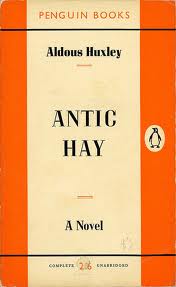
Book Review: Antic Hay (1923) by Aldous Huxley

Most people know Aldous Huxley only from having read his Brave New World (1931), probably as part of a course on Utopian literature. It's one of those books that a great many people end up having to read, rather than wanting to read. It's a good novel, but it's not really a fair representation of what Huxley the novelist was all about. Huxley began his career as a satirist, and Antic Hay is a dark and vicious look at the poseurs and pseuds inhabiting London's bohemian world just after WW I. Evelyn Waugh would follow very closely in Huxley's creative footsteps only a few years later and ended up with more popular and enduring success. Both writers took a caustic look at their contemporaries, but Waugh's less abstruse prose style and clear plots have kept him popular with readers and BBC film producers.

Antic Hay follows a half-dozen or so characters who form a kind of sampler pack of bohemians; there's Mercaptan the effete, womanizing writer of irrelevant scholarly articles; Lypiatt the blustering, self-important artist; Coleman the bombastic hedonist; and Theodore Gumbril, the main character, a dissatisfied intellectual who quits his teaching job to pursue a fatuous scheme to invent and sell trousers containing an inflatable seat for added comfort. The women in the group include Myra, a dark muse to two of the male characters, and Rosie, a bored housewife.

The plot is a kind of dance in which various characters pair off for an hour, an evening or a day to expound their beliefs, strike intellectual poses or seduce each other. More often than not they come across as monstrously affected, self-absorbed and pretentious. Although Huxley's intention is satirical (characters are given ludicrous names like Bruin Opps), the novel has a dark edge that makes it more than just a benign jab at some ridiculous personalities. Myra appears to be a casually cruel, cold-hearted beauty, but Huxley shows that she's been terribly damaged, like so many others, by the death of a loved one in the war. Similarly, Lypiatt initially comes across as a buffoon, but at the end of the novel he comes to a devastating realization that his artistic life has been a failure and a farce. The last we see of him he's probably on the verge of blowing his brains out.

Something that all the characters share is a realization that the world has changed profoundly and that there are no certainties or truths to anchor themselves to anymore. The nineteenth century ended with WW I, and the years following the war saw a sea change in the arts, fashion, politics and music. Huxley's characters are lost in this new world and their eccentric behaviour can be seen as a way of dealing with the stress of these changes. Huxley's writing also reflects the changes going on at the time. On the one hand he flaunts his classical education with references and quotes from Greek and Latin (not to mention his characters occasionally using those languages as well as French and Italian), but on the other hand he abandons a traditional plot structure in favour of something more freewheeling and unpredicatable. Huxley is clearly aware that thanks to Marcel Proust and James Joyce the idea of what a novel should be has been utterly transformed. Huxley produced an even more non-traditional novel, Eyeless In Gaza, in 1936.

Antic Hay is a mostly amusing novel, although at times Huxley's erudite style can be grating, and the changes in tone from comic to serious to philosophical aren't always managed well. The strength of the novel lies in Huxley's ability to tease out the fear and uncertainty at the heart of his main characters. The spirit of the novel is captured best in this passage:

"And besides, when the future and the past are abolished, when it is only the present instant, whether enchanted or unenchanted, that counts, when there are no causes or motives, no future consequences to be considered, how can there be responsibility, even for those who are not clowns?"