Showing posts with label Ken Bruen. Show all posts

Thursday, August 1, 2013

Book Review: The Doll Princess (2012) by Tom Benn

The Doll Princess emphatically check marks the crime fiction box labeled "noir," and does so with energy, wit and style. These days noir is shorthand for a setting that's exceedingly grim; visceral and grisly acts of violence; and sex that's frequent and sometimes brutal. Having praised it, I now have to, if not damn it, at least laugh at it a little. A lot of modern noir crime novels have a tendency to wallow in grittiness and sordidness to a degree that becomes, well, risible. You reach a point in some of these novels where you're fondly imagining Graham Chapman's army officer character from Monty Python suddenly intruding on the action to declare that what began as a nice hard-boiled crime story has just gotten "too silly." This novel sometimes strays over the line into noir silliness, but on the whole it's a solidly entertaining thriller.

The Doll Princess, like other novels in the noir field by authors such as Ray Banks, Declan Hughes and Ken Bruen, makes a determined effort to paint its fictional world in a palette consisting of blacks and, well, more blacks. The plot is a minor reworking of the Michael Caine film Get Carter. Henry Bane, an enforcer for a Manchester crime boss, learns that an ex-girlfriend from his teenage years has been found murdered. Bane investigates. For no clear reason the action is set in 1996, shortly after a deadly IRA bombing in the city. The IRA doesn't factor into the plot, so I'm left wondering why we're in 1996. Was that a particularly noir period in Manchester's recent history? Along the way we encounter a sex ring, a new kind of street drug, and bloodthirsty Serbian gangsters. We also get some spiky British gangland dialogue, and our hero, like any hard-boiled gumshoe from the 1930s, takes a beating or two but keeps on coming, dropping wisecracks along the way. Bane is what holds the novel together. Like Raymond Chandler's Philip Marlowe, Bane moves in a noir world, but he himself holds on to some humanity; he's bad, but he's better than those around him. A lesser writer would have made Bane as dark and disturbed as the milieu he moves in. What I could have done without was so much violence being directed towards women, and a few too many laddish descriptions of sex and female body parts. And Serbian gangsters? Really? As villains, Serbian baddies have become the modern cliche equivalent of gypsy horse thieves. Be warned that all the dialogue is written in a Manchester accent--no concessions for non-Mancunians. Thanks to having a mother who watched Coronation Street religiously when I was kid, I coped quite well. I just imagined I was listening to Stan and Hilda Ogden.

Reviews of noir crime novels routinely describe them as gritty and realistic, often making disparaging references to the Midsomer Murders end of the crime fiction spectrum. In truth, noir mysteries are every bit as divorced from reality as a story set in Chipping Badger featuring a killer poisoning people in order to win a raffle at the church fete. The latter kind of mystery, with its warm and fuzzy characters and lashings of cream teas, is a mild literary opiate for middle-class readers who like their fictional crime to come in a neat, attractive package with all the appropriate government warning labels. Noir is a mild amphetamine for middle-class readers who like to think their fictional crime choice gives them a kind of vicarious street cred; it allows them to feel that, in a very small way, they know what life on the edge is like. These readers are looking for, as the saying goes, "a bit of rough." At least writers of cosy mysteries are aware that they're peddling pablum, and none of them ever argue that they should be winning literary awards. The noir writers, on the other hand, take themselves very seriously indeed. They often grumble about not making the Booker Prize longlist. But the darker and nastier they make their novels, the more they stray into a noir fantasy land that's an exercise in willful, cranky dystopianism.

Friday, December 7, 2012

Noir More Crime Fiction

He'd slap contemporary noir writers silly.
I used to read a fair amount of crime fiction. A lot, actually. In the last three or four years I've found myself reading less of it, and in the last year or so I find that the novels I give up on the soonest are crime novels. Just this week I had to throw in the towel on The White Road by John Connolly. Connolly sells a lot of books and collects some enthusiastic reviews, but he's not much of a writer. The White Road is a clumsy, sluggish mashup of the private eye genre allied with a whiff of Stephen King horror. Oddly, Connolly is an Irish writer who sets his crime novels in the US. I say oddly because based on the 200 or so pages I read, Connolly's knowledge of America has come entirely from occasional glances at CNN. I could forgive him for calling sneakers "trainers", but when he has three elderly rednecks sitting in a bar in the Deep South watching "a rerun of a classic hockey game" you have to wonder if he could actually find the US on a globe. But enough about Connolly; my real beef here is with crime fiction, particularly the writers, like Connolly, who are described as "noir".

In truth, publishers and critics use the term "noir" with the same promiscuity as the snack food industry uses "Cajun-style." It's a buzzword. Too often what it means are writers who follow a formula that's as trite and predictable as a cosy mystery featuring cats and vicars. One aspect of noir that really tires me out are detectives who are emotionally scarred by a) the tragic death of a wife and/or child, or b) a horrible crime from the past that they were unable to prevent and/or solve. And for some unlucky detectives options A and B are combined in one horrible event. Too often writers seem to think that going this route is a quick and easy way to give their protagonist depth and gravitas. Declan Hughes, Ken Bruen and Connolly all have detectives living with terrible memories, but none of these psychological scars seem convincing; it's all window dressing in the Noir Crime Shop.

The noir detective also needs to be a substance abuser to hold onto his street cred. In The Dying Breed by Declan Hughes his detective, Ed Loy, almost always has a glass in his hand. One reason I quit that book is that Ed's drinking became farcical: in the course of one day's investigation he sinks so much booze he should have ended up in a coma. It's at that point that one realizes the author isn't really paying attention to reality or logic, he's just playing the noir game. Fellow noirists like Bruen, Colin Bateman and Ray Banks also like to keep their detectives pickled and/or pilled up. As with personal tragedies, the drinking detective has come to feel like a paint-by-numbers way of creating a character.

Noir crime writers are also overly fond of letting us know what their detectives like to listen to. In the past few years I've read mysteries by Ken Bruen, Massimo Carlotto, and Gianfranco Carofiglio in which their detectives' musical preferences are regularly mentioned. It's a pedestrian way to build a character, and the worst part is that these Desert Island Discs moments always (for me) break down the fourth wall. I feel like I'm being buttonholed by the author for a bit of a natter about his favourite songs and artists. Not surprisingly, these detectives always have excellent taste in music. I blame Elmore Leonard. He introduced the idea of characters referencing their choices in music and movies, and after that the genie was out of the bottle. One of these days I'd like to see a mystery writer give us a brilliant detective with really horrible taste in music. How about a sleuth who only listens to ABBA and Slim Whitman?

The problem with some of today's noir writers is that they feel all aspects of their stories have to be dark and tragic, including their detectives. The detectives created by Dashiel Hammett and Raymond Chandler, the original noir crime writers, weren't steeped in darkness. Those detectives were cynical, rough-edged and world-weary, yes, but it was their environment and job that was noir, not the detectives themselves. Part of what made them interesting as characters is that they were apart from the world they moved in. They had the psychic toughness to survive in that world, but they are observers of the noir world, not direct participants.

Now that I've vented, here are some writers who have a better idea of what constitutes noir crime writing. First up is Adrian McKinty, originally from Northern Ireland and now residing in Australia. His trilogy of crime novels featuring the roguish Michael Forsythe are fast, violent, nasty and written with a gleeful, feverish imagination. Most importantly, the Forsythe character steers clear of the usual noir tropes. He's funny, smart and has few regrets. McKinty's newest creation is Sean Duffy, a RUC cop in Belfast circa 1981. Duffy is the rarest kind of cop: he actually likes his work, and if drinks it's for the pleasure of drinking, not to drown sorrows.

Next up is Dominique Manotti, a French writer who specializes in gritty, sexy police procedurals that lay bare the corrupt inner workings of French high society. Manotti has a political axe to grind and she's not afraid to name names as she kicks the crap out of big business and the political elites. Her detective is Commissaire Daquin, who's tough, mean and enthusiastically gay. Manotti's got my vote as best current crime writer anywhere; I just wish she'd speed up her writing schedule.

And last we come to Mike Carey. Carey's detective is Felix Castor, and he's Philip Marlowe in everything but name. Here's the catch, though: Castor is an exorcist. The Castor novels are in the urban fantasy genre, but are, in fact, the best pure noir novels being written today. Castor investigates and battles demons and ghosts, but they might just as well be kidnappers or murderers; the language, the characters, the plotting, it's all pure, classic noir, and Casey's a vastly entertaining writer.

I'll keep plugging away at finding decent crime writers, but from now on if I see the word "noir" used in a blurb or review I'll be looking elsewhere.

Related posts:

Book Review: The Cold Cold Ground by Adrian McKinty
A Tale of Two Dominiques (an overview of Manotti's work)
Book Review: Thicker Than Water by Mike Carey

Thursday, April 12, 2012

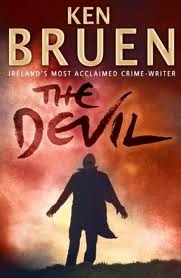
Book Review: The Devil (2010) by Ken Bruen

WTF? I say again, WTF? This is my first Ken Bruen novel, and I had understood that he's a crime writer, but what we have here is a private eye taking on...Satan. And this isn't a one-off novel, it's the latest in a series featuring p.i. Jack Taylor, who works out of Galway, Ireland. As far as I know the previous Taylor novels have no supernatural content. So, the Devil comes to Galway and begins committing a series of exceedingly nasty and cruel murders. The victims are people Jack knows or has recently met. The Devil's motivation, aside from being, well, fiendish and evil, is that Jack unknowingly interfered with one of his petty schemes in a previous novel. Naturally enough, Jack doesn't believe he's dealing with the Devil off the top, but by the end of the novel he, and we, are convinced that the mysterious and wealthy Kurt is the Prince of Darkness.

Needless to say, the basic concept of The Devil is absolutely bonkers, even laughable. Somehow, though, the ridiculousness of the story didn't bother me that much. The main reason is that Bruen is a spectacularly good writer. His prose is electric with tension and violence, and his humour is very, very dark. I say prose, but at points his style becomes consciously poetic with paragraphs and sentences broken down in to something like stanzas. Bruen, like so many Irish writers past and present, is clearly in love with words, the sound of them, the meaning of them, even the look of them. With writing this good, story and plot almost becomes of secondary interest.

I said almost. There are two ways to look at the Devil's presence in the story. First, he could be a paranoid delusion that exists only in Jack's mind. One character even suggests this, and it does seem possible since Jack exists solely on a diet of Jameson's whiskey, Guinness and Xanax. This doesn't seem likely given that another character, Ridge, independently comes to the conclusion that Kurt is the Devil. The other way to look at this novel is to see the Devil as a symbol of Ireland's moral and financial collapse. This seems like the most plausible explanation. The novel's major theme is Ireland's decline and the horrors of the recent past, from the Troubles to the revelations about abusive priests and nuns. When not trying to figure out if he's dealing with the Devil, Jack is constantly harping about everything in Ireland having turned to "shite." There's really no aspect of modern Ireland Jack doesn't run roughshod over, and he can't forget the crimes of the past. He also seems miffed that so many non-Irish are living and working in Ireland, and it's interesting that Kurt is described by witnesses as speaking with an accent that is, at times, either French or German. Hmm, sounds like Bruen's not a great fan of the EU. Another possible clue that The Devil is intended as a rant about Ireland is that one point Jack mentions that maybe he should just hole up and read his collection of K.C. Constantine novels. Constantine is a mostly obscure American crime writer who, like Bruen, is brilliant at writing dialogue. His detective is Mario Balzic, a small town police chief in Pennsylvania. Balzic appeared in eleven books and one of the later novels was a hardcore rant about the awful state of the USA in the Reagan years. There was no real mystery in that novel (the title escapes me), just the spewing of a lot of pent-up venom. I have a piece on Constantine here. The Devil seems to have been written in a similar vein; it's the eighth Jack Taylor novel and it has very little mystery but a lot of rage that Bruen wants to get out of his system.

As loopy as the Devil's presence is it didn't bother quite as much as the character of Jack Taylor. Jack isn't a poorly written character, but I have a low tolerance for tormented detectives, and Jack has a black belt in self-loathing. Outside of cosy mysteries, it sometimes seems like all detectives are tormented in one way or another; in fact, I think it must be an EU regulation that all Scandinavian fictional detectives must be angst-ridden. In short, the tortured detective is a cliche, and while Jack is certainly entertaining, it bothered me that he was yet another in a long and tedious line of detectives who only find comfort in the bottom of a bottle.

Whether the Devil is real or symbolic or a delusion doesn't change the fact that The Devil is a lot of fun. Fun might not sound like the right word, but Bruen's way with words kept me delighted throughout. And the plot certainly has its fair share of tension and violence. I'm going to try the first Jack Taylor novel and, fingers crossed, it won't involve poltergeists or elementals; best to leave that kind of thing to Mike Carey.