Showing posts with label Mike Carey. Show all posts

Thursday, March 5, 2015

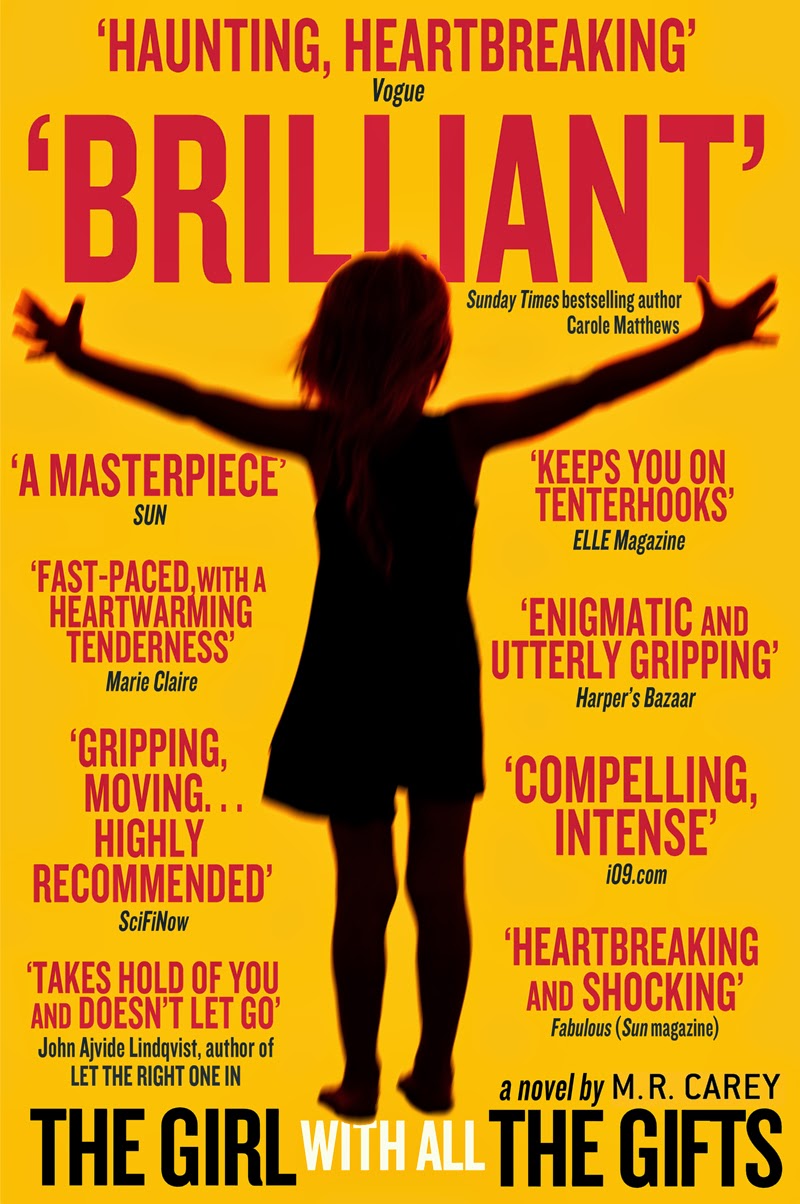
Book Review: The Girl with All the Gifts (2014) by M.R. Carey

I find zombie films tiresome and relentlessly unscary, if that's a word, so I surprised myself by thoroughly enjoying this post-apocalypse zombie thriller. Sorry, that's hungries, not zombies. Author M.R. Carey goes out of his way not to use the z-word. I'm not sure why he does this, and it definitely seems odd that none of his human characters use the z-word, but I guess in the crowded field of zombie films, zombie graphic novels, zombie TV shows and zombie novels, you do whatever it takes to stand (lurch?) out from the crowd. But enough about etymology and on to the eating of flesh!

The setting is England twenty or so years hence. A nasty fungus that normally infects ants has somehow jumped species and turned almost all of humanity (the English portion of it, anyway) into crazed zombies hungries. The hungries are akin to the zombies in 28 Days Later; they move fast and they never give up. They also have extra strength and heightened senses. The story begins on a fortified army base where a group of children are being held captive. It emerges that the kids are hungries who, unlike all other hungries, retain their intelligence and personality along with an uncontrollable desire to eat human flesh. They're kept restrained and locked up. The land outside the base is overrun with hungries and "junkers", who live and act much like the bad guys in the Mad Max films. The brightest of the children is 10 year-old Melanie, who is in love with her teacher, Ms. Justineau. Justineau is racked with guilt because she knows that the children are only being kept alive so that Dr. Caroline Caldwell can dissect them in an attempt to find a cure for the plague of hungries. The children are unaware that they are hungries and have no knowledge of the world outside their cells. A band of junkers overruns the camp and Melanie, Caldwell, Justineau and two soldiers, Parks and Gallagher, escape together. They have go on foot to the Beacon, some kind of redoubt located south of London. But that place of safety is a long way off in a land filled with dangers, not the least of which is Melanie, who is trying to manage her urge to eat her companions.

Like I said, I don't care for the zombie genre, but Carey is such a good writer he manages to get past my walking dead defenses. The appeal of the novel, aside from its well-crafted moments of violence and peril, lies in the character of Melanie. She's a sweet child with a love for all the new things the world has to show her, but at the same time she has to control the inner demon that wants to turn her into a remorseless killer. This inner conflict gives the novel its backbone and its most touching moments. The remaining characters are good, but they betray the novel's origins (as we learn in an afterword) as a failed screenplay. Caldwell, Justineau, Parks and Gallagher all fit neatly into their respective action movie character slots--cold-hearted scientist, vocal moralist, grizzled grunt, greenhorn grunt. Carey handles these characters very effectively, but at times they feel a bit too celluloid. The ending betrays its film roots with a scene that's very neat, that brings things full circle, but also makes no sense. That aside, M. R. Carey (the unimaginative pseudonym of Mike Carey) may have made me a convert to zombie fiction. but his best work remains the Felix Castor novels. And here's my piece on why I have a beef with the living, shambling dead.

Monday, July 28, 2014

Book Review: Turbulence (2013) by Samit Basu

As newspapers have folded or drastically slimmed down as a result of people getting their news and opinion from the web, one crucial piece of collateral damage has been the demise of the newspaper book review. Once upon a time any half-decent book would appear in paperback bearing blurbs from newspapers both large and small, anything from the New York Times to the Kingston Whig Standard. These reviews weren't a foolproof guide to a book's quality, but it was a lot better than the situation we're in now. These days paperbacks arrive on the shelves barnacled with glowing reviews from bloggers, online fanzines, and other authors. The problems here are obvious. The bloggers and fanzines are usually uncritical promoters of most anything that falls into their field of interest, and authors are doing favours for friends, publishers, or in the expectation of getting their complimentary reviews repaid in kind. It's become common to come across cabals of authors in various genres and sub-genres who seem to have nothing but good things to say (in print) about their fellow club members. It's all very cosy and does a great disservice to readers.

Having been burnt several times in the past by novels recommended by authors, I've no one but myself to blame for reading Turbulence. The fact that four of the quoted reviews are from blogs with the word "geek" in their name should have provided ample warning. But wait! I think I'll blame Mike Carey and Ben Aaaronovitch, two of the best writers in the urban fantasy fiction genre, because their gushing reviews of Basu's novel are what made take a chance on it. I won't quote their blurbs, if only to spare them the embarrassment. Turbulence is about what happens when the passengers on a London to Delhi flight arrive at their destination to find that they've all been gifted with superpowers, from the odd to the frightening. What follows can charitably be described as fan fiction for people besotted with Marvel's X-Men franchise. There are cinematic fight scenes, much fretting over the responsibility of having great power, and a lot of B-grade quips. The only creative wrinkle is that all the characters are Indian. Basu had a great opportunity to do something more with his concept, specifically the idea of superheroes all being members of the developing world. One intriguing aspect of comic book superheroes is that at one level they are projections of Western (primarily U.S.) power and ideals. How does being an Indian superhero change what a superhero does? Would the caste system still exist amongst Indian superheroes? From Untouchable to Unstoppable? There are a lot of cultural and political ramifications to the idea of Indian superheroes and Basu hasn't addressed any of them.

The SF/Fantasy field is stuffed with bland and bad writing, and good writers like Carey and Aaronovitch don't do readers any favours by pointing them towards vanilla novels like Turbulence. In fact, they damage the reputation of their genre as a whole by promoting books that any discriminating reader is going to be disappointed by. Clearly, the publishing world needs a superhero who has the power to stop first-rate authors from promoting second-rate novels.

Friday, December 7, 2012

Noir More Crime Fiction

He'd slap contemporary noir writers silly.
I used to read a fair amount of crime fiction. A lot, actually. In the last three or four years I've found myself reading less of it, and in the last year or so I find that the novels I give up on the soonest are crime novels. Just this week I had to throw in the towel on The White Road by John Connolly. Connolly sells a lot of books and collects some enthusiastic reviews, but he's not much of a writer. The White Road is a clumsy, sluggish mashup of the private eye genre allied with a whiff of Stephen King horror. Oddly, Connolly is an Irish writer who sets his crime novels in the US. I say oddly because based on the 200 or so pages I read, Connolly's knowledge of America has come entirely from occasional glances at CNN. I could forgive him for calling sneakers "trainers", but when he has three elderly rednecks sitting in a bar in the Deep South watching "a rerun of a classic hockey game" you have to wonder if he could actually find the US on a globe. But enough about Connolly; my real beef here is with crime fiction, particularly the writers, like Connolly, who are described as "noir".

In truth, publishers and critics use the term "noir" with the same promiscuity as the snack food industry uses "Cajun-style." It's a buzzword. Too often what it means are writers who follow a formula that's as trite and predictable as a cosy mystery featuring cats and vicars. One aspect of noir that really tires me out are detectives who are emotionally scarred by a) the tragic death of a wife and/or child, or b) a horrible crime from the past that they were unable to prevent and/or solve. And for some unlucky detectives options A and B are combined in one horrible event. Too often writers seem to think that going this route is a quick and easy way to give their protagonist depth and gravitas. Declan Hughes, Ken Bruen and Connolly all have detectives living with terrible memories, but none of these psychological scars seem convincing; it's all window dressing in the Noir Crime Shop.

The noir detective also needs to be a substance abuser to hold onto his street cred. In The Dying Breed by Declan Hughes his detective, Ed Loy, almost always has a glass in his hand. One reason I quit that book is that Ed's drinking became farcical: in the course of one day's investigation he sinks so much booze he should have ended up in a coma. It's at that point that one realizes the author isn't really paying attention to reality or logic, he's just playing the noir game. Fellow noirists like Bruen, Colin Bateman and Ray Banks also like to keep their detectives pickled and/or pilled up. As with personal tragedies, the drinking detective has come to feel like a paint-by-numbers way of creating a character.

Noir crime writers are also overly fond of letting us know what their detectives like to listen to. In the past few years I've read mysteries by Ken Bruen, Massimo Carlotto, and Gianfranco Carofiglio in which their detectives' musical preferences are regularly mentioned. It's a pedestrian way to build a character, and the worst part is that these Desert Island Discs moments always (for me) break down the fourth wall. I feel like I'm being buttonholed by the author for a bit of a natter about his favourite songs and artists. Not surprisingly, these detectives always have excellent taste in music. I blame Elmore Leonard. He introduced the idea of characters referencing their choices in music and movies, and after that the genie was out of the bottle. One of these days I'd like to see a mystery writer give us a brilliant detective with really horrible taste in music. How about a sleuth who only listens to ABBA and Slim Whitman?

The problem with some of today's noir writers is that they feel all aspects of their stories have to be dark and tragic, including their detectives. The detectives created by Dashiel Hammett and Raymond Chandler, the original noir crime writers, weren't steeped in darkness. Those detectives were cynical, rough-edged and world-weary, yes, but it was their environment and job that was noir, not the detectives themselves. Part of what made them interesting as characters is that they were apart from the world they moved in. They had the psychic toughness to survive in that world, but they are observers of the noir world, not direct participants.

Now that I've vented, here are some writers who have a better idea of what constitutes noir crime writing. First up is Adrian McKinty, originally from Northern Ireland and now residing in Australia. His trilogy of crime novels featuring the roguish Michael Forsythe are fast, violent, nasty and written with a gleeful, feverish imagination. Most importantly, the Forsythe character steers clear of the usual noir tropes. He's funny, smart and has few regrets. McKinty's newest creation is Sean Duffy, a RUC cop in Belfast circa 1981. Duffy is the rarest kind of cop: he actually likes his work, and if drinks it's for the pleasure of drinking, not to drown sorrows.

Next up is Dominique Manotti, a French writer who specializes in gritty, sexy police procedurals that lay bare the corrupt inner workings of French high society. Manotti has a political axe to grind and she's not afraid to name names as she kicks the crap out of big business and the political elites. Her detective is Commissaire Daquin, who's tough, mean and enthusiastically gay. Manotti's got my vote as best current crime writer anywhere; I just wish she'd speed up her writing schedule.

And last we come to Mike Carey. Carey's detective is Felix Castor, and he's Philip Marlowe in everything but name. Here's the catch, though: Castor is an exorcist. The Castor novels are in the urban fantasy genre, but are, in fact, the best pure noir novels being written today. Castor investigates and battles demons and ghosts, but they might just as well be kidnappers or murderers; the language, the characters, the plotting, it's all pure, classic noir, and Casey's a vastly entertaining writer.

I'll keep plugging away at finding decent crime writers, but from now on if I see the word "noir" used in a blurb or review I'll be looking elsewhere.

Related posts:

Book Review: The Cold Cold Ground by Adrian McKinty
A Tale of Two Dominiques (an overview of Manotti's work)
Book Review: Thicker Than Water by Mike Carey
Tuesday, October 9, 2012

Book Review: Thicker Than Water (2008) by Mike Carey

In an afterword to this novel Mike Carey describes how a section of it that takes place in Liverpool, where he was born and raised, morphed into something painfully autobiographical. He then had to do an edit to keep things more fictional and protect the innocent and guilty. Carey's act of flying too close to his autobiographical sun has paid off in what, up to now, is the best of the Felix Castor novels.

Felix Castor is an exorcist/gumshoe from the Philip Marlowe school of hard knocks and wisecracks, and he works in a contemporary London that has become infested with various forms of the undead. In this outing he finds himself accused of the murder of a childhood enemy who's been found slashed to death on a no-hope south London estate of giant apartment blocks. Felix soon determines that the entire estate is in the grip of violence that centres on stabbing and slashing, and behind it lurks a demonic presence. It also seems that the murder and the presence of the demon are events that have roots in Felix's past in Liverpool. I'll draw a veil over the rest.

What helps makes this book the best in the series is that Carey gets the balance between the mystery and the supernatural perfectly right. His previous book, Dead Men's Boots, was weak on the supernatural elements and was further marred by two supporting and recurring characters who ended up doing too much of the heavy lifting in the story. Carey's writing also seems sharper, darker, angrier, and I'm thinking that the autobiographical elements pushed him into producing something that's more serious. The previous novels are, at heart, bloody, but fun, romps around an alternate reality London that sits solidly in the urban fantasy genre. This novel strays into Ruth Rendell territory with a mystery that's as rooted in psychology and affairs of the heart as it is the supernatural. And the scenes set in Liverpool have an angry intensity and attention to gritty detail that brings Alan Sillitoe to mind. Not many fantasy writers manage to transcend their genre, but Carey's done it with Thicker Than Water.

Friday, August 10, 2012

Book Review: Sixty-One Nails (2009) by Mike Shevdon

I wouldn't normally review a book I quit halfway through, but in this case the novel's failures point out the strengths of two very similar authors. Sixty-One Nails is in the urban fantasy genre, the urban in this case being London. The protagonist is Niall, a nobody-in-particular until he collapses on a Tube platform with what looks like a heart attack. It turns out he's just survived an attack by the Untainted, the name given to pure blood fairies, or Feyre, as they're called here. It seems that Niall is some kind of half-breed fairy and the Untainted want to kill people of his ilk. Niall is saved by Blackbird, a fairy woman, and she explains that there are seven Feyre courts residing in London, and Niall must seek the protection of one of them.

I threw in the towel on Nails for two reasons: one, the plot kept slipping back and forth from first to neutral. Two, Shevdon is vanilla all the way when it comes to prose and world-building his magical London. The pedestrian prose isn't a major problem (J.K. Rowling has made billions with an ABC writing style), but when it's allied with a second-rate imagination it creates a fatal problem. Shevdon's attempts to describe magic and the magical world are weak and infrequent; they all feel like slightly reworked bits from Harry Potter and Star Wars. He also succumbs to the curse of many fantasy writers: prolixity. Rowling was one of the worst offenders in this regard in the last four Potter books, but she's far from alone. I know from having shelved books at the library for five plus years that sci-fi/fantasy writers are the pulp and paper industry's best friends. In Nails, a lot of the excess paper consumption stems from the characters spending far too much time debating their every move and option. Poor Niall can't open a door without having a long natter about it. And London, as a setting, is not used to full advantage. A few place names are mentioned, but other than that the action might as well be taking place in Chicago.

Shevdon is working the same side of the street as Mike Carey and Ben Aaronovitch. Both of these authors write urban fantasy series set in London. Carey's features a private eye/exorcist named Felix Castor, and Aaaronovitch's hero is Peter Grant, a young copper and apprentice wizard. Both writers keep their stories moving at a brisk pace, and their magical elements are clever and believable, not just add-ons to liven up a standard adventure story. Both of these writers make London come alive in their novels; in fact, in both series London qualifies as an important secondary character, not just a location. Carey & Aaronovitch have their faults (Carey's books could use some pruning), but if you want to attempt an urban fantasy series they're the boys to measure yourself against. Here are my reviews of the latest appearances by Felix Castor and Peter Grant.

Wednesday, June 27, 2012

Book Review: Dead Men's Boots (2007) by Mike Carey

This is the third of Mike Carey's supernatural mystery/thrillers featuring Felix Castor, exorcist and literary son of Philip Marlowe. A lot of fictional detectives, supernatural or regular flavour, share some or all of Marlowe's DNA, but Carey pretty much goes the full monty. That's not a mark against Carey since he's an excellent writer and his sleuth is as lively and entertaining as the original. I only mention it because this time around Carey has written a mystery that relies less on the supernatural. Not a lot less, but in comparison with the previous Castor books (reviews here and here) this one is halfway to being a straight mystery.

In this adventure Castor is asked to prove the innocence of a man convicted of murder. The evidence against him is overwhelming to the point of redundancy, but some elements of the crime also point to the involvement of an American serial killer. The only problem is that the American has been dead for quite a while. While investigating this case Felix is also looking into the death of a fellow exorcist whose spirit has evidently turned into a poltergeist.

Carey has many strengths as a writer: he can spin out dense, twisty plots with ease; his dialogue is sharp; and his descriptions of the supernatural are always inventive and powerful. This novel, like the previous two, could easily be a bit shorter, but a greater problem that rises up in this novel is the use of two recurring characters who act as deus ex machinas. Nicky Heath is a zombie and computer genius, and Felix turns to him whenever he needs background info. Juliet is a succubus (a kind of demon) who has temporarily retired from her evil ways, but she's still a very powerful creature who more than evens the odds in a fight with the real or the unreal. Both are interesting characters, but in this novel Carey (and Felix) start to rely on them too much. It's really a case of lazy writing. Whenever Carey needs Felix to learn some facts and figures, Nicky pops up to hammer a keyboard and come up with the goods. And when Felix needs some muscle, supernatural or otherwise, Juliet is conveniently there to break heads. Of the two, Nicky is the most annoying. The computer geek who has all the answers has now become a stock character in film and literature. Whenever a hero or heroine needs to access a database of some kind the geek is there to effortlessly provide all the answers with a minimum of fuss and a maximum of attitude. This kind of character is roughly equivalent to the "stoolie" or "snitch" or "grass" of previous years. Their main purpose is to spare the lead character (and the author) the drudgery of going through files and so on.

Dead Men's Boots is quite entertaining, but I'm a little worried that Carey might not be keeping his eye on the ball. The diminished supernatural elements in this novel are a tad disappointing, and Nicky's role as the all-knowing computer genie needs to be reduced. Similarly, Juliet becomes less interesting the more she's simply used to fulfill the role of the cavalry coming to the rescue.

Thursday, April 12, 2012

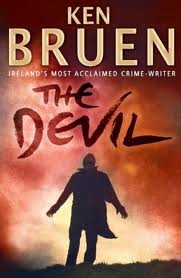
Book Review: The Devil (2010) by Ken Bruen

WTF? I say again, WTF? This is my first Ken Bruen novel, and I had understood that he's a crime writer, but what we have here is a private eye taking on...Satan. And this isn't a one-off novel, it's the latest in a series featuring p.i. Jack Taylor, who works out of Galway, Ireland. As far as I know the previous Taylor novels have no supernatural content. So, the Devil comes to Galway and begins committing a series of exceedingly nasty and cruel murders. The victims are people Jack knows or has recently met. The Devil's motivation, aside from being, well, fiendish and evil, is that Jack unknowingly interfered with one of his petty schemes in a previous novel. Naturally enough, Jack doesn't believe he's dealing with the Devil off the top, but by the end of the novel he, and we, are convinced that the mysterious and wealthy Kurt is the Prince of Darkness.

Needless to say, the basic concept of The Devil is absolutely bonkers, even laughable. Somehow, though, the ridiculousness of the story didn't bother me that much. The main reason is that Bruen is a spectacularly good writer. His prose is electric with tension and violence, and his humour is very, very dark. I say prose, but at points his style becomes consciously poetic with paragraphs and sentences broken down in to something like stanzas. Bruen, like so many Irish writers past and present, is clearly in love with words, the sound of them, the meaning of them, even the look of them. With writing this good, story and plot almost becomes of secondary interest.

I said almost. There are two ways to look at the Devil's presence in the story. First, he could be a paranoid delusion that exists only in Jack's mind. One character even suggests this, and it does seem possible since Jack exists solely on a diet of Jameson's whiskey, Guinness and Xanax. This doesn't seem likely given that another character, Ridge, independently comes to the conclusion that Kurt is the Devil. The other way to look at this novel is to see the Devil as a symbol of Ireland's moral and financial collapse. This seems like the most plausible explanation. The novel's major theme is Ireland's decline and the horrors of the recent past, from the Troubles to the revelations about abusive priests and nuns. When not trying to figure out if he's dealing with the Devil, Jack is constantly harping about everything in Ireland having turned to "shite." There's really no aspect of modern Ireland Jack doesn't run roughshod over, and he can't forget the crimes of the past. He also seems miffed that so many non-Irish are living and working in Ireland, and it's interesting that Kurt is described by witnesses as speaking with an accent that is, at times, either French or German. Hmm, sounds like Bruen's not a great fan of the EU. Another possible clue that The Devil is intended as a rant about Ireland is that one point Jack mentions that maybe he should just hole up and read his collection of K.C. Constantine novels. Constantine is a mostly obscure American crime writer who, like Bruen, is brilliant at writing dialogue. His detective is Mario Balzic, a small town police chief in Pennsylvania. Balzic appeared in eleven books and one of the later novels was a hardcore rant about the awful state of the USA in the Reagan years. There was no real mystery in that novel (the title escapes me), just the spewing of a lot of pent-up venom. I have a piece on Constantine here. The Devil seems to have been written in a similar vein; it's the eighth Jack Taylor novel and it has very little mystery but a lot of rage that Bruen wants to get out of his system.

As loopy as the Devil's presence is it didn't bother quite as much as the character of Jack Taylor. Jack isn't a poorly written character, but I have a low tolerance for tormented detectives, and Jack has a black belt in self-loathing. Outside of cosy mysteries, it sometimes seems like all detectives are tormented in one way or another; in fact, I think it must be an EU regulation that all Scandinavian fictional detectives must be angst-ridden. In short, the tortured detective is a cliche, and while Jack is certainly entertaining, it bothered me that he was yet another in a long and tedious line of detectives who only find comfort in the bottom of a bottle.

Whether the Devil is real or symbolic or a delusion doesn't change the fact that The Devil is a lot of fun. Fun might not sound like the right word, but Bruen's way with words kept me delighted throughout. And the plot certainly has its fair share of tension and violence. I'm going to try the first Jack Taylor novel and, fingers crossed, it won't involve poltergeists or elementals; best to leave that kind of thing to Mike Carey.

Sunday, April 1, 2012

Book Review: Moon Over Soho (2011) by Ben Aaronovitch; Vicious Circle (2006) by Mike Carey

I'm reviewing these two supernatural mystery/thrillers together because the authors are creatively joined at the hip. Both have created an alternate reality London in which the supernatural is very real and very dangerous.

Aaronovitch's previous novel featuring DC Peter Grant was Rivers of London (my review here), and it was a very successful attempt to combine the world of the supernatural with a police procedural. It sounds unlikely, but he pulled it off. The only serious problem with Rivers was that the plotting was weak, with a major sub-plot about the gods of London's rivers going nowhere. Moon is equally entertaining, but also suffers from plot problems. The story this time revolves around the mysterious deaths of various jazz musicians, and then there's the strange and dangerous Pale Lady, a woman with a very feline personality. Moon is a very fun read, but once again Aaronovitch does a poor job of handling multiple storylines. The Pale Lady story eventually connects with the deaths of the musicians, but it's not obvious how or why it does. Or maybe I just wasn't paying enough attention.

Mike Carey has no problem with plots. His novels are rich with incident and detail, and the plots are well-developed. In the second Felix Castor novel (the first is reviewed  here) Felix is up against a cult seeking to raise one of Hell's fiercest demons. Carey takes the private eye route with his novels, making Castor a Philip Marlowe of magic. The previous Castor novel was way too long, and this one is also a bit prolix. One example: long after Carey has established that Castor is good at picking locks, he has his hero give a long description of a lock he ends up not picking. Simply put, Vicious could be significantly leaner with no drop in literary quality.

An interesting thing about Aaaronovitch and Carey is that they make London one of their main characters. In both novels the action rarely moves out of the city, and the authors are almost loving in their descriptions of the city's streets, buildings and neighbourhoods. Both writers are also equally good at world-building. London invaded by the supernatural seems quite likely in the hands of these writers. Finally, the Grant and Castor novels deserve to be praised as mysteries every bit as much as they get respect as supernatural thrillers. Plot problems and prolixity aside, these writers create more  mystery and excitement than a great many straight mystery writers.

Friday, December 2, 2011

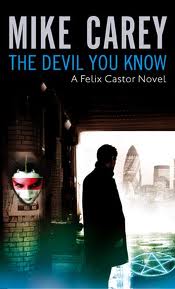
Book Review: The Devil You Know (2006) by Mike Carey

This supernatural thriller/murder mystery is remarkably similar to Rivers of London, a novel I reviewed exactly a month ago. Both novels offer an alternative reality version of London in which ghosts and various supernatural baddies plague the general citizenry. Rivers had a cop/wizard as its hero, while this novel has a freelance exorcist named Felix Castor taking top billing.

Felix specializes in ridding homes and businesses of ghosts. The ghosts in London are just your common or garden variety ghosts, and there are lots of them, but their ordinariness doesn't stop them from scaring the crap out of Londoners, and that's where Castor comes in. He exorcises ghosts with the aid of a tin whistle; he essentially "whistles" them out of existence. That sounds silly, but Carey doesn't an excellent job of making the magical elements in his alternate world feel believable. In relation to this, he also does a great job of what's known in fantasy writing as "world-building." Carey's London is gritty, detailed, and the supernatural elements fit quite smoothly into this milieu. In this story Castor investigates a ghost haunting an archive in central London. He also has to deal with a murderous vice lord with a zombie henchman, and a succubus who wants his soul. 

Castor's job title is exorcist, but he's basically a gumshoe: Philip Marlowe in everything but name. And take away the ghosts and demons, and the plot of The Devil You Know is pure hardboiled murder mystery. Castor gets slapped around, cracks wise, and can't resist a damsel (or ghost) in distress. The problem with the plot is that it goes on and on and on. The final quarter of the story, when things should be speeding up, feels bogged down with lengthy background stories and explanatory passages. Devil isn't lardy and prolix the way the final Harry Potter books were, but it definitely would have benefited from some pruning.

Putting aside the plot problems, this is a very entertaining read. The supernatural bits have a visceral thrill, and the characterization is much better than average. In these respects Devil is superior to Rivers of London. Where the latter scores better is the plot, which was lean and efficient, albeit a bit shambolic towards the end. This is the first of six Felix Castor adventures, and I'll definitely give the next one a try.