Showing posts with label K.C. Constantine. Show all posts

Wednesday, April 22, 2015

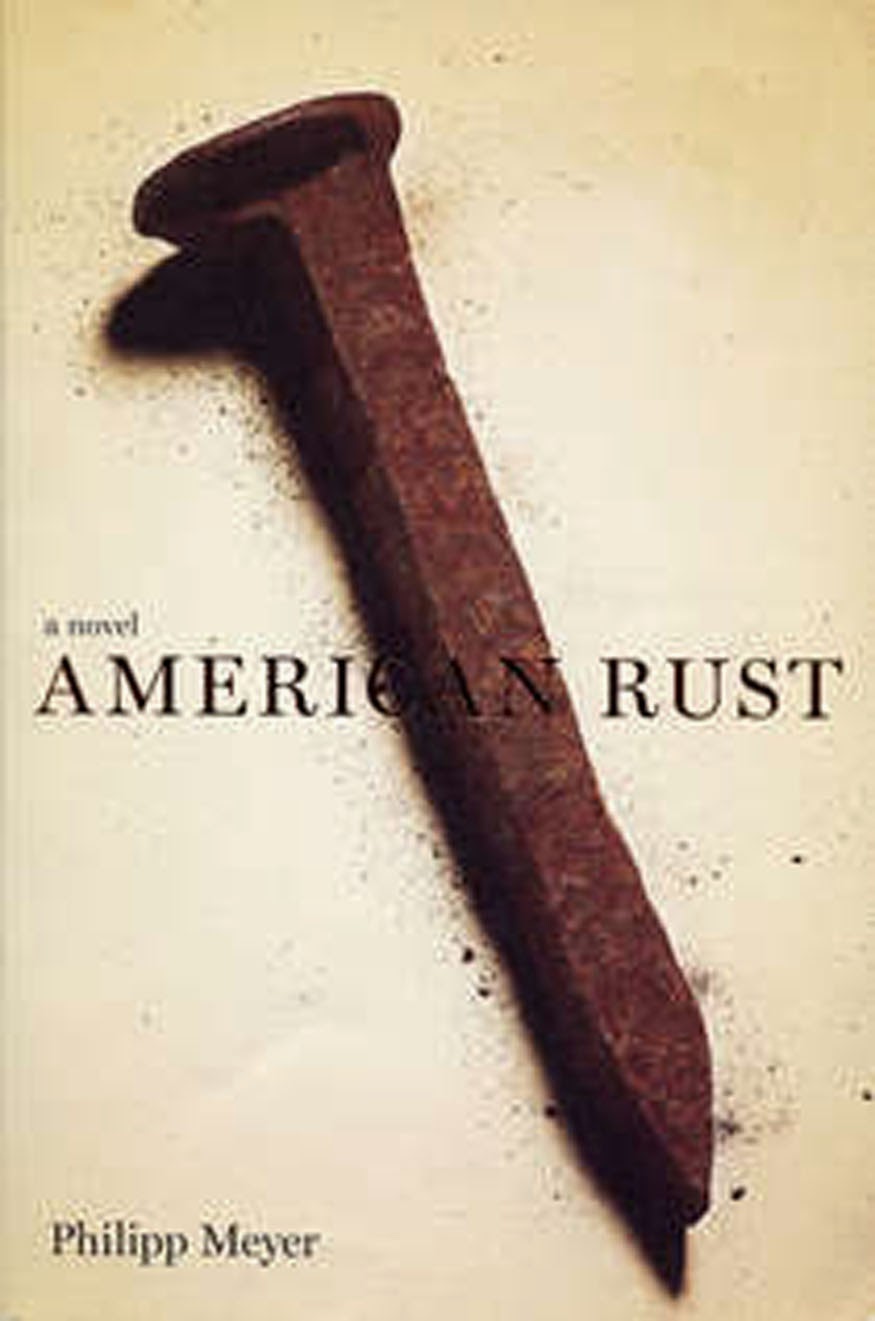
Book Review: American Rust (2009) by Philipp Meyer

This is Meyer's debut novel, and I'm so glad I read his second, The Son (my review), before this one. The Son is big, bold, self-assured and its few flaws are the result of too much ambition. American Rust reads like a novel created by a committee tasked with putting out a literary version of a multi-part New York Times piece on life in the Rust Belt. That Meyer is a good writer isn't in doubt; he writes sharp dialogue, his characters (the male ones, anyway) are rugged, edgy and painfully real, and his descriptions of landscapes, urban and natural, are superb. The problem here is that his novel doesn't have the ambition to be more than just a literary litany of what ails Pennsylvania's coal and steel towns.

The two central characters are Isaac and Billy, best friends, both barely out of their teens, and both unsure what to do with their lives. They live in Buell, PA, and like every other town in the region it's been economically devastated by the death of the US steel industry. Those who aren't unemployed are working for minimum wage or are living a semi-criminal life. Isaac steals some money from his crippled father and decides to hit the road to California by hopping freight trains. Billy, an ex-high school football star, opts to accompany him for no better reason than it seems like a good idea at the time. They are an unlikely pair; Isaac is a weedy brainiac and Billy is a jock with a penchant for violence. They've barely started on their journey when they have an altercation with three homeless men that ends with Isaac accidentally killing one of them by way of defending Billy. A few days later Billy is arrested and charged with the murder, which he doesn't deny in an act of self-sacrifice to give some meaning to his selfish and wasted life. Isaac, meanwhile, goes on the run. Isaac's and Billy's fractured families are drawn into the story, but it's at this point that the story runs aground. The novel is told from the POV of a half dozen or so characters, but what's missing is a compelling narrative. Once Billy's arrested the story drags its feet as we hear from the different characters and their stories of despair and struggle in the heart of the Rust Belt. The only tension or narrative momentum is provided by Billy's stint in jail as he awaits trial and faces the wrath of prison gangs. The writing in this section is excellent, but it could just as well have been dropped in from a standard crime fiction novel.

American Rust is brimming with sympathy for its beaten-down characters and the region that's become an industrial dust bowl. What's missing from this story, what makes the novel so frustrating, is that Meyer shies away from bringing politics into the story. The plight of people in the Rust Belt is entirely the result of a series of ruinous political and economic decisions made by politicians and corporate executives stretching back decades. Meyer barely hints at the factors that impoverished this region. It's akin to writing a novel set in Vichy France and not mentioning the war or the Nazis. The virtually apolitical outlook of the novel isn't unusual in American literature. European writers, especially in the crime fiction field, enthusiastically bring politics and big business into their stories. American writers can't seem to get past their nation's religious belief that the individual and the individualism is everything. They don't seem happy with the idea that a character can be a hopeless victim or puppet of forces beyond his control. Or perhaps they feel that the nuts and bolts of politics and high finance don't have a place in literature. Nineteenth century writers such as Zola, Balzac, and Trollope happily took on these subjects, but the only American of that ilk that comes to mind is Gore Vidal.

Meyer's novel ticks all the boxes when it comes to mentioning issues like drug abuse, unemployment, underemployment, municipal underfunding, poor healthcare, and so on, but without giving these issues any historical or sociological context, Meyer is doing a disservice to the very people he so clearly sympathizes with. The people in the Rust Belt know they've been victimized by politicians and big business, but in American Rust this catastrophe is almost presented as a natural disaster, something that happened for no rhyme or reason.

The committee feel to the novel comes from the inclusion of far too many stock characters and tropes from modern literary fiction. There's the suicide of a mother that damages the children; the Ivy League woman who can't resist the manly charms of Billy the jock; the embittered father, broken in body and mind; and the young, tortured genius who's just too sensitive for this world. And does anyone actually ride the rails these days? Last of all, it has to be said that Meyer is poaching on literary territory created and mastered by K.C. Constantine (my piece on hiin is here), who wrote a series of crime novels set in Pennsylvania's coal and steel country. Constantine, however, was not afraid to bring politics into the mix.

Tuesday, October 15, 2013

Book Review: A Very Profitable War (1984) by Didier Daeninckx

If, like me, you relish crime fiction that has a political component, then you're resigned to the fact that your choices will be restricted to authors writing in languages other than English, which means the supply of such fiction is limited by what editors and publishers think is worth translating. UK and US crime writers seem gun shy when it comes to politics. They'll sometimes take notice of the symptoms of bad or corrupt political decisions (poverty, urban decay, racism, etc.), but they generally avoid tackling politics head-on. The late Elmore Leornard, for example, set at least a dozen novels in Detroit, a city that has come to symbolize all that is wrong and dysfunctional in American society and politics. But Leonard doesn't have anything to say about the whys and wherefores that turned Detroit into an urban wasteland. He records the symptoms of Detroit's decline but has no apparent opinions on why this has come to pass. The same neutral attitude towards societal ills is a commonplace one with a great many of his English language contemporaries.

Non-Anglo writers such as Massimo Carlotto, Yasmina Khadra, Dominique Manotti and Didier Daeninckx wholeheartedly embrace the political. For them, crime is inextricably linked with political decisions and the political zeitgeist. Their novels reflect the fact that politics and society can have as great a role in fictional murder and mayhem as traditional motives like greed, jealousy and rage. A Very Profitable War is set in Paris in 1920, and our hero is Rene Griffon, a veteran who was recently in the trenches and is now a private eye. He's hired by a retired general who's being blackmailed over his wife's serial indiscretions. What begins as a simple case of marital infidelity turns into a story about war crimes, radical post-WW I politics in Paris, and corporate greed.

The political themes don't make the novel dry or preachy; quite the contrary. Daeninckx's prose style is positively ebullient, full of jokes and energy, and the same can be said about Rene Griffon. As in his Murder in Memoriam (review here), Daeninckx wants to lay bare some of the dirty secrets from France's past. In this case he's concerned with the repression of anarchist and communist movements during and just after the war. These issues add some depth and resonance to the novel, making it more than just an exercise in style and mood. And style and mood is what too many contemporary crime fiction is all about. A great deal of noir or hard-boiled crime fiction works hard to create a gritty, sour, dystopian worldview, but the authors have little interest in explaining why these conditions exist; instead we get a lot of characters (including the sleuths) with deep and dark psychological problems that must be talked about at great length. There's certainly room for both kinds of crime fiction, but it would be nice to see more agitprop writing on the English language side of the ledger. After all, it was Eric Ambler, an English writer, who invented the politically-informed thriller. One American crime writer with a taste for politics is K.C. Constantine (read my piece on him here), although I think he's currently retired from writing. He offers an interesting comparison with Elmore Leonard. Constantine set all his crime novels in a small area of rural Pennsylvania, and he isn't shy about describing the political errors and crimes that have ruined the lives of people in that part of America. Leonard's resolutely apolitical stories stand in stark contrast to Constantine's, although in many ways they are literary blood brothers.

Sunday, July 22, 2012

Book Review: Brushback (1998) by K.C. Constantine

If you've never heard of mystery writer K.C. Constantine you can probably blame the man himself. Constantine began his series of mystery novels set in fictional Rocksburg, PA, in 1972, and until 2011 he avoided publicity and interviews with the single-mindedness of a J.D. Salinger. That's a pity because he's a writer who deserved a much higher profile.

Rocksburg and its environs are to Constantine what Yoknapatawpha County was to William Faulkner. K.C. loves and hates Rocksburg. He has a love and respect for the hard-working Italian and Hungarian immigrants who settled the area and built its steel mills and coal mines, and he has a red hot hatred for the politicians at all levels who have slowly and consciously let the local economy slide into Rust Belt oblivion. Like Faulkner, Constantine is fascinated by his own "little postage stamp of soil" and over the course of 17 novels he introduces us to a very wide variety of its citizens.

Most of the Rocksburg mysteries feature Mario Balzic, the town's police chief. Balzic is not so much a detective as he is the town's confessor-in-chief. Rocksburg's citizens are an exceptionally talkative bunch and Balzic is adept both at listening to them and at drawing out their stories. Balzic doesn't solve crimes through forensic evidence; he talks and listens and talks some more and teases out the motivations that lead to murders. Constantine eschews the evidence side of detection because he's more interested in creating a portrait of the people he grew up with.

Constantine's writing style is best described as regional vernacular. His novels consist almost entirely of dialogue, and they're rich in the slang and accents of western Pennsylvania. And Constantine isn't interested in crisp, tight dialogue. Constantine writes duologues that wander off in all directions, with asides that can last for a sentence, a paragraph or a page. In this way, layer by layer, he builds up his portrait of people whose lives are defined by hard work and blue collar pleasures. The dialogue is always pungent, frequently humorous, and always respectful of the characters. It's normally the case that when an author writes dialogue for a working-class character we're meant to be amused or appalled by the tortured syntax, the dropped g's, and the grotesque malapropisms. Constantine, as Faulkner did, puts poetry and truth into the words of his townspeople.

The sympathy and interest Constantine has for his working-class characters is pretty much unique in American crime fiction. The working-class world in most mysteries is usually just a breeding ground for crimes and criminals. Constantine makes the working class the heart and soul of all his novels. This is another reason that his novels have flown under the radar. The working-class is almost a taboo subject in the U.S.: no one wants to be identified as a member of it or even be reminded that it exists. It takes a certain courage to write a whole cycle of novels that revolve around a social class most readers ignore or feel frightened of. Constantine even likes to discuss the issue of class, particularly the way in which America's ruling elites have ignored and harassed the working class.

Having praised Constantine I now have to knock Brushback. This novel is one of the last in the series and it's pretty weak. There is barely a plot and the dialogue has lost a lot of its punch. What's worse, Constantine's commentaries on class and politics have become straightforward editorializing. Brushback still has strong elements, but it's not the equal of the first eight or nine novels. I can't really recommend Brushback but it's a reminder of how unique and brilliant the balance of this mystery series is.

Thursday, April 12, 2012

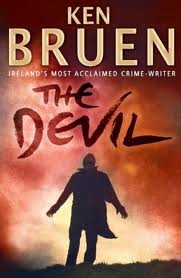
Book Review: The Devil (2010) by Ken Bruen

WTF? I say again, WTF? This is my first Ken Bruen novel, and I had understood that he's a crime writer, but what we have here is a private eye taking on...Satan. And this isn't a one-off novel, it's the latest in a series featuring p.i. Jack Taylor, who works out of Galway, Ireland. As far as I know the previous Taylor novels have no supernatural content. So, the Devil comes to Galway and begins committing a series of exceedingly nasty and cruel murders. The victims are people Jack knows or has recently met. The Devil's motivation, aside from being, well, fiendish and evil, is that Jack unknowingly interfered with one of his petty schemes in a previous novel. Naturally enough, Jack doesn't believe he's dealing with the Devil off the top, but by the end of the novel he, and we, are convinced that the mysterious and wealthy Kurt is the Prince of Darkness.

Needless to say, the basic concept of The Devil is absolutely bonkers, even laughable. Somehow, though, the ridiculousness of the story didn't bother me that much. The main reason is that Bruen is a spectacularly good writer. His prose is electric with tension and violence, and his humour is very, very dark. I say prose, but at points his style becomes consciously poetic with paragraphs and sentences broken down in to something like stanzas. Bruen, like so many Irish writers past and present, is clearly in love with words, the sound of them, the meaning of them, even the look of them. With writing this good, story and plot almost becomes of secondary interest.

I said almost. There are two ways to look at the Devil's presence in the story. First, he could be a paranoid delusion that exists only in Jack's mind. One character even suggests this, and it does seem possible since Jack exists solely on a diet of Jameson's whiskey, Guinness and Xanax. This doesn't seem likely given that another character, Ridge, independently comes to the conclusion that Kurt is the Devil. The other way to look at this novel is to see the Devil as a symbol of Ireland's moral and financial collapse. This seems like the most plausible explanation. The novel's major theme is Ireland's decline and the horrors of the recent past, from the Troubles to the revelations about abusive priests and nuns. When not trying to figure out if he's dealing with the Devil, Jack is constantly harping about everything in Ireland having turned to "shite." There's really no aspect of modern Ireland Jack doesn't run roughshod over, and he can't forget the crimes of the past. He also seems miffed that so many non-Irish are living and working in Ireland, and it's interesting that Kurt is described by witnesses as speaking with an accent that is, at times, either French or German. Hmm, sounds like Bruen's not a great fan of the EU. Another possible clue that The Devil is intended as a rant about Ireland is that one point Jack mentions that maybe he should just hole up and read his collection of K.C. Constantine novels. Constantine is a mostly obscure American crime writer who, like Bruen, is brilliant at writing dialogue. His detective is Mario Balzic, a small town police chief in Pennsylvania. Balzic appeared in eleven books and one of the later novels was a hardcore rant about the awful state of the USA in the Reagan years. There was no real mystery in that novel (the title escapes me), just the spewing of a lot of pent-up venom. I have a piece on Constantine here. The Devil seems to have been written in a similar vein; it's the eighth Jack Taylor novel and it has very little mystery but a lot of rage that Bruen wants to get out of his system.

As loopy as the Devil's presence is it didn't bother quite as much as the character of Jack Taylor. Jack isn't a poorly written character, but I have a low tolerance for tormented detectives, and Jack has a black belt in self-loathing. Outside of cosy mysteries, it sometimes seems like all detectives are tormented in one way or another; in fact, I think it must be an EU regulation that all Scandinavian fictional detectives must be angst-ridden. In short, the tortured detective is a cliche, and while Jack is certainly entertaining, it bothered me that he was yet another in a long and tedious line of detectives who only find comfort in the bottom of a bottle.

Whether the Devil is real or symbolic or a delusion doesn't change the fact that The Devil is a lot of fun. Fun might not sound like the right word, but Bruen's way with words kept me delighted throughout. And the plot certainly has its fair share of tension and violence. I'm going to try the first Jack Taylor novel and, fingers crossed, it won't involve poltergeists or elementals; best to leave that kind of thing to Mike Carey.

Thursday, February 9, 2012

Book Review: Eye of the Cricket (1998) by James Sallis

This is the first I've heard of James Sallis, although it turns out the film Drive (my review's here) was based on his novel of the same name. And he's written a sequel called, naturally enough, Driven. I'm guessing the third in the series will be called Driving. Anyway, Cricket is one of seven novels Sallis has written featuring private detective Lew Griffin. Griffin is black, a resident of New Orleans, and in this novel a part-time university prof teaching modern literature and French. Reading between the lines it would seem that Griffin was once more of a full-time private dectective.

Cricket presents the problem of the crime writer who doesn't appear to be all that interested in writing about crime. In this novel Griffin investigates a couple of missing persons cases in a laidback sort of way that involves a lot of eating and drinking in colourful New Orleans eateries while asking questions of obligingly talkative friends and acquaintances. In this way we get an engaging tour of the city, but there isn't really any detection going on. And the final 40 or so pages have Griffin living on the street in order to find his son who disappeared in New York several years previously. The missing son portion the story is poorly developed and makes for a limp, saccharine finale.

Sallis isn't the first crime writer to lose interest in crime. Michael Dibdin's series of mysteries featuring Comissario Aurelio Zen eventually became mood pieces with a bit of crime on the side. American mystery writer K.C. Constantine hit the wall after nine books about Mario Balzic, the Chief of Police of Rocksburg, PA. He rejuvenated himself by retiring Balzic and writing about his replacement, but before that happened his last two Balzic novels were nothing more than extended rants about life in America under Ronald Reagan.

Sallis' focus in this novel is on Griffin coping with middle age and dealing with the demons of his past. Sallis is a good writer, sometimes a fine writer with a Faulknerian way with words, but his ability to craft prose can't disguise the fact that he isn't really interested in telling a story. Another sign that Sallis is more interested in creating a literary novel is that he has Griffin quoting and referencing famous authors at a furious clip. That kind of thing is never a good idea; it always seems to be a substitute for storytelling. I can't recommend this book, but I'm curious to see if Sallis is a more disciplined writer in Drive and the earlier Griffin novels.