Showing posts with label Sujit Saraf. Show all posts

Monday, August 18, 2014

Book Review: Man-Eaters of Kumaon (1944) by Jim Corbett

"Gone native" is a term of mild disapprobation that the British once used to describe fellow colonial officials who had taken too great an interest in the people they were ruling over. Going native could mean anything from speaking the local language, eating and dressing like the natives, or even, at the most politically dangerous end of the colonial spectrum, being supportive and respectful of local culture and/or independence movements. Lawrence of Arabia is the poster boy for going native, but the British Empire produced a handful of others who put a human face on colonialism.

Jim Corbett (1875-1955) was one such man. Born and raised in India, he was part of the small army of British bureaucrats, politicians, military men, engineers, and businessmen who managed the jewel in Britain's imperial crown. Corbett was in many ways more Indian than British. He spoke the local dialects, he spent most of his life in a remote area of India, and aside from military service during World War One, he barely seems to have set foot in the UK. Corbett  became famous in the late 1940s with a series of books about India's flora and fauna, the life of the rural poor, and, most famously, his exploits hunting down man-eating tigers and leopards.

Man-eater is almost too mild a term for the animals Corbett faced-off against. These tigers and leopards didn't just kill a few people, in some cases they had killed hundreds. One tiger is reputed to have killed more than 500 people in Nepal before being driven out of that country by the army. It set up shop in India where it killed another 400+ before being bagged by Corbett. These were the Blofelds and Hannibal Lecters of the animal kingdom. Corbett's stories of tracking and killing man-eaters are small masterpieces of narrative tension. Corbett isn't the most poetic or fluid writer, but his clear, workmanlike prose works beautifully in bringing alive the tensions and terrors of tracking man-eaters on foot through dense jungle. What makes Corbett's stories more than just plus-sized hunting pieces are his joyful descriptions of the natural world. He knew and understood everything that went on in the jungle and he brings that knowledge to the reader with a contagious enthusiasm. Perhaps the most notable feature of these hunting tales is the empathy Corbett displays for India's peasants. His writing makes it clear that his primary concern in shooting the man-eaters isn't the challenge it poses but the relief it brings to villages and regions paralyzed with grief and fear. It's Corbett's humanity, his love and concern for India's poorest people, that really makes these books something more than tales of adventure.

Corbett's interest in India's rural poor and working classes is even more evident in My India (1952), a mix of anecdotes about his non-hunting career, scenes from rural life, and an extended piece about his involvement in the hunt for Sultana, a legendary brigand who terrorized the United Provinces in the 1920s. Corbett was asked to take part in this police action because of his prowess as a tracker. Corbett has nothing but respect for Sultana, and he makes it very clear that because Sultana was a member of one of India's "official" criminal classes, his depredations were inevitable and blameless. It's hard to imagine any other British colonial official of that era taking as kindly or understanding a view of Sultana. It's undoubtedly for this reason that Corbett makes a cameo appearance in Sujit Saraf's The Confession of Sultana Daku (2009), a wonderful fictional retelling of Sultana's story (my review here). Corbett's affection for Sultana is also definitive proof that he had "gone native." At some point, consciously or unconsciously, he stopped seeing Indians as colonial subjects but as fellow citizens, and that's what makes Corbett's writings more lasting and significant than if they simply concentrated on hunting and nature.

Wednesday, July 2, 2014

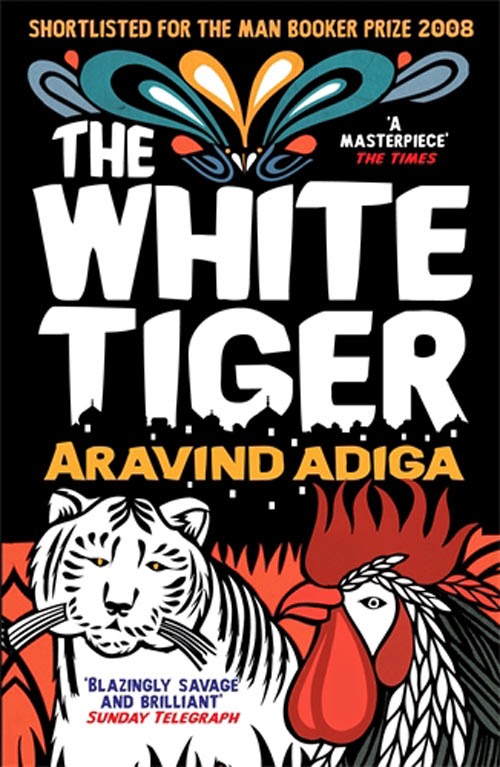
Book Review: The White Tiger (2008) by Aravind Adiga

The White Tiger took the Man Booker prize in 2008, and I choose to believe that it won because the jury felt that they'd stupidly overlooked Sujit Saraf's similar, but much better, novel about modern India, The Peacock Throne (my review), which came out one year previously. Adiga's novel is very good, but it feels like an amuse-bouche appetizer before the high in protein main course of Saraf's book. But on with the review.

The white tiger of the title is Balram, once a peasant in deepest, darkest, most backward India, but now the owner of a fleet of cabs in Bangalore. The novel is written as a series of letters from Balram to the Chinese Premier, who is about to make a state visit to India. Balram feels that because he's climbed from the bottom rung of Indian society to somewhere near the middle, he's perfectly positioned to tell the Premier the truth about India. Balram does this by describing how, through luck and one fateful murder, he managed to reinvent himself as a successful businessman in India's capital of hi-tech..

The strength of The White Tiger (and this applies to almost every Indian novel I've read) is that it enthusiastically takes on subjects such as class conflict, the lives of the working poor, the cruelty of unfettered capitalism, and the corruption and viciousness of Indian politics. Modern Western novels rarely tackle subjects such as these, and working-class characters usually only make regular appearances in crime fiction, most often as perps or victims. The White Tiger is not a dire or dreary examination of hard times in India. Adiga, like his Indian peers, uses wit to make the basic horror of Balram's story palatable. Balram is a consistently amusing narrator even as he's describing the noxious nature of village life, or the demeaning and dehumanizing details of master-servant relationships.

Where this novel didn't work for me was in the character of Balram. He's entertaining, but he's also too much of a fictional artifice. The idea that Balram would write letters to the Chinese Premier works well as a comical, but very artificial, narrative device, but that also ends up applying to Balram; he never feels like more than a deftly-handled, but weightless, comic character who wouldn't exist outside the pages of the book. The same problem, to a far worse extent, handicapped Monica Ali's Brick Lane, set in London's South Asian community, which was shortlisted for the Man Booker in 2003 . And Adiga isn't always consistent with his character: one minute Balram is presented as woefully ignorant and the next he's using a word like "oleaginous."

I'm still recommending The White Tiger, but its issues and themes have been handled better and more imaginatively in The Peacock Throne and, more recently, by Manu Joseph in Serious Men (my review). Finally, it's interesting that Brick Lane and The White Tiger both gained Man Booker approval with stories featuring male South Asian characters who are somewhat absurd and/or laughably naive. The more realistic characters of Saraf and Joseph don't seem to fit Western tastes.

Monday, March 3, 2014

Book Review: The Confession of Sultana Daku (2009) by Sujit Saraf

All the cool kids are writing historical fiction. Check over the long and short lists for the Booker Prize over the last ten years or so and you see a lot of novels set in the past, including winners like Wolf Hall, Bring Up the Bodies, The Luminaries and True History of the Kelly Gang. I don't know why this is so, but it seems to be a relatively recent development. It's hard to think of many celebrated writers from the 1920s through to the '50s who tried their hand at historical fiction. Sujit Saraf's previous novel was The Peacock Throne (my review), a big and brilliant novel about life in the Chandi Chowk area of New Delhi. The Confession of Sultana Daku is based on a true story and is set in the United Provinces of India in the 1920s. Saraf follows the titular bandit's short but spectacular criminal career from sneak thief to leader of a large and murderous gang. The activities of the gang eventually led to the British authorities taking notice. The army was called in, and after months of pursuit Sultana Daku was captured and hanged.

The novel is written in Sultana's voice, on the eve of his execution, as he tells his life story to an English officer who writes down everything he says. Sultana wants his life recorded so that the son he's never seen can learn what a great bandit his father was. Sultana's narrative is interrupted at times by entries from the officer's journal that describe some of the background to the manhunt.

The brilliance of this novel lies in its portrayal of Sultana. The bandit is boastful, self-pitying, occasionally delusional, and yet he remains a sympathetic character because we're aware that he's presenting himself this way because his audience is a British officer. Sultana's trying to impress a sahib, show him that his life counted for something despite being a member of one of India's lowest and most reviled castes, and at the same time he's reveling in the chance to have the undivided attention of a member of the one caste that rules all the other castes. In the background of the story, Ghandi and the Congress Party are taking the first steps on the road to winning India's independence and ending the culture and traditions that made Sultana a bandit, and make him feel privileged to speak with a sahib. As zero hour approaches for Sultana his mythomania drops away and he's revealed as a terrified man who'll beg and plead for his life. It's at this point that the novel fully captures the sadness and tragedy of life for India's "untouchables."

The political and social aspects of Sultana Daku give the story added depth, but what makes it additionally exceptional is Saraf's rich, vibrant prose. His descriptions of the land and people, the environment that Sultana swims in, are wonderfully realized, and it's no surprise that in an author's note at the beginning of the novel Saraf gives a mention to the books of Jim Corbett. Corbett was a hunter of India's man-eating tigers in the 1920s, and he wrote several books that are wonderfully evocative of the Indian countryside and sympathetic to India's peasants. Saraf even gives Corbett a cameo appearance in the story.

The only thing I can complain about is that this book needed an introduction to explain some of the historical background. Sultana is a victim of India's Criminal Tribes Act of 1871, and a full description of it off the top would have cleared up some confusion early in the story. A glossary might also be in order, although I don't really mind being thrown in at the deep end with novels about times and places that are foreign to me. But the fact that this novel has been barely reviewed outside of India (The Peacock Throne was widely reviewed outside of India) might be down to the fact that for a non-Indian reader much of the novel is going be tough sledding. Tough, but very, very rewarding.

Friday, November 9, 2012

Book Review: The Peacock Throne (2007) by Sujit Saraf

Maybe I'm just lucky or perhaps writers from the Indian subcontinent are a cut above everyone else, but every novel I've read from that part of the world seems to be better than the last. The Peacock Throne is the best so far. Although it was only published in 2007 it already seems to have fallen into the category of forgotten gems. I say this because it appears to be out of print, and it has only garnered a measly three reviews on Amazon. Make that four reviews after I post this one.

The first and most obvious point of reference for describing The Peacock Throne is to compare it to a Dickens novel. There's the same multitude of characters, the journalistic attention to detail, and a fascination with the sheer variety of human experience. The central character is Gopal, a lowly tea seller in the sprawling Chandi Chowk market of New Delhi. His life becomes the central point in a carousel of schemes and plots and crimes that, in turn, have their roots in some of the seismic events in the political life of India between the years 1984 and 1998.

Saraf has chosen a very large canvas for his story and he fills every inch of it with incident and detail. What makes this saga different from run-of-the-mill epics is that Saraf is passionate about his characters. Many of the people we meet are venal, shifty or corrupt, but they're brought to life so emphatically, so enthusiastically one ends up with a rooting interest in all but the worst of them. I have only the barest knowledge of recent Indian history, but it's pretty clear that one of Saraf's aims with his novel is to show that the average Indian, as represented by Gopal, is both a victim and a tool of India's political and mercantile elites. Democracy is alive in India, but it's often drunk and disorderly. Speaking of which, don't think that because there's a political angle to this novel it's confusing or tedious. This is a wildly entertaining novel. There's sex, violence, humour and intrigue aplenty: all the ingredients of a best-seller with the added bonus that they've been put together by a superb writer. Now that I think of it, another writer Saraf should be compared to is Balzac. Saraf has the same fondness and gift for describing the Byzantine scheming of the merchant classes as they scramble for wealth and power.

An excellent companion piece to this novel is Serious Men by Manu Joseph. It's central character is also low on the totem pole, but, unlike Gopal, he decides to get a measure of revenge on his superiors. It's interesting that both novels (as far as I can tell by Googling reviews) did not receive a warm reception in India. I think if you're writing any kind of epic novel about a nation you should take that as a compliment.

Related posts:
Book Review: Serious Men by Manu Joseph
Book Review: The Sweet and Simple Kind by Yasmine Gooneratne
Book Review: Partitions by Amit Majmudar

Tuesday, July 24, 2012

Book Review: Partitions (2011) by Amit Majmudar

Over the short lifetime of this blog I've frequently touted Rafik Schami (my reviews here, here and here) as a writer whose fiction provides some background to the whys and wherefores of the Arab Spring. Majmudar does something in a similar vein in Partitions, a novel about the cruel, chaotic and bloody division of Imperial India into three separate countries in 1947. Majmudar's novel isn't political in tone or outlook, but the horrors he so artfully describes go a long way to explaining the past and current tensions between India and Pakistan.

Partitions is plotted like a thriller and written like an epic poem. The novel follows four individuals caught up in the two-way exodus that preceded the creation of Pakistan. Muslims are heading west to resettle in land that will become Pakistan, and Hindus and Sikhs are fleeing east to India. All the refugees are preyed upon by murderous sectarian mobs, as are those who choose to stay on the wrong side of the border. Hundreds of thousands of people would eventually be killed in the upheavals surrounding Partition. The four people at the centre of the novel are Masud, a Muslim doctor; Simran, a Sikh teenage girl; and two Hindu boys, Keshav and Shankar.

All four characters face death on more than one occasion, and their progress to safety is fraught with tension and harrowing episodes of violence. It's in this regard that Partitions reads like a thriller: characters are left in cliffhanger situations and frequently leap from the frying pan into the fire. The novel has an epic poem quality thanks to the author's audacious decision to make his narrator a ghost. Yes, a ghost. The spirit is that of Dr. Jaitly, the father of Keshav and Shankar. He died months before Partition and he now watches over events, flitting from place to place like a Greek god in The Iliad to observe events and, on occasion, to make ineffectual attempts to intervene in the life and death struggles he witnesses.

Majmudar's decision to make the narrator a ghost is a bold one. Some readers are going to find that this is a distracting or ridiculous narrative device, but I think his intention is to give the novel a voice of humanity and empathy that's divorced from a sectarian viewpoint. Jaitly the ghost sees horrors in a way that Jaitly the mortal would never be able to. Having a ghost as a narrator also lends itself to Majmudar's finely crafted prose. Majmudar is a poet as well, and it shows in sentences like this one describing Masud standing beside a column of refugees:

The family is staring at him. A gentleman heron perfectly still against a background of shuffling migration.

Jaitly has an impressionistic view of what goes around him, conveying violence and distress and hatred with finely-formed, terse descriptions that seem all the more powerful for being brief. Another writer might have gone for lengthy, gritty descriptions of the various horrors of  Partition, but the economical, poetic approach seems to work better in this case. And on a purely aesthetic level there's no disputing that Majmudar is fine writer.

The only problem I had with Partitions is that the ending brings together the four characters in a symbolically convenient manner that's a bit too cozy and predictable. That aside, Partitions is yet another world-class novel from the Indian sub-continent. In the last few years just about every novel I've read from that region has been better than the last. Here are my reviews of novels by Manu Joseph and Yasmine Gooneratne, and although I haven't reviewed it yet, I have to mention Sujit Saraf's The Peacock Throne, which may have to rate as the Great Indian Novel.