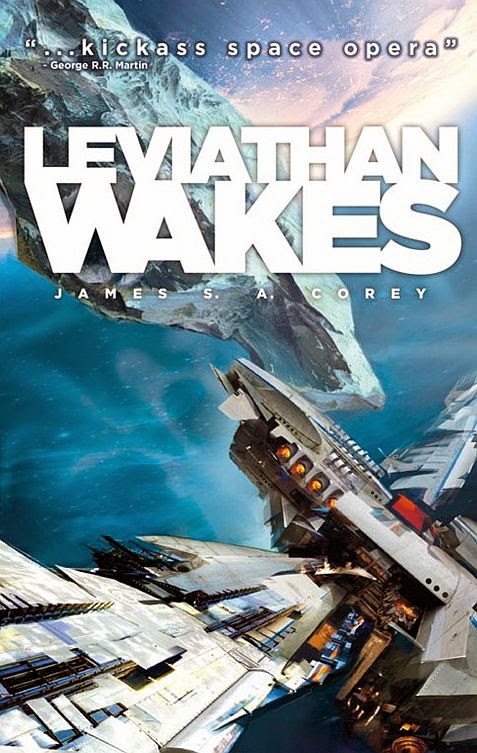
This is meat and potatoes SF writing, but the respective protein and vegetable components are of a very high quality. More specifically, this is an SF novel that's conceived and written to be one of the best SF films of the 1980s or '90s; it's basically a film script in novel form, and the obvious influences are Alien, Aliens, Outland and Blade Runner. This isn't a "hard" SF story, the kind that delves deeply into the effects of scientific or technological changes on a future society; this is about tough men and women who swear, drink and fornicate, and also get caught up in a monstrous corporate plot that threatens to destroy the solar system.
The two main characters are described in broad strokes--brave space captain, hard-bitten space cop--with just a little bit of extra shading (a bit of humour here, a dash of exstential despair there) to make them more than just cartoons. Secondary characters run the gamut from good ol' boys to slick corporate baddies to grrl power femmes, all of whom are familiar to us from every action movie of the last thirty years. The plot is a deftly-constructed series of revelations and cliffhangers, and the action scenes follow the templates laid down in most every SF film.
Leviathan Wakes is a clean, efficient, enjoyable piece of genre writing that's devoid of any original style or exciting prose, but what makes it interesting is that it's the product of two writers working under the Corey pen name: Daniel Abraham and Ty Franck. The only dual author novel I've read previously was Good Omens by Terry Pratchett and Neil Gaiman. That novel read exactly like any other Pratchett book, and I was left wondering if Neil's only contribution was to bring Terry tea and Jaffa cakes when he was feeling peckish. Leviathan is no-frills blue collar writing, but it's also an example of error-free writng. Something that too many genre novels (SF, fantasy, mystery, crime) have in common are literary "speed bumps." What I mean by speed bumps are those moments in a novel that make me put down the book, groan, and wonder why an editor wasn't around to say, "Uh, you might want to rewrite that last bit."
This isn't really about bad writing. Lots of modern genre novels feature decent prose, but too often they feel like a rough draft rather than a finished product. For every genre novel I read, I probably abandon two others because they need heavy pruning; have serious, but fixable, plot problems; are barnacled with clumsy pop culture references; get caught up in referencing genre conventions; and have underdeveloped lead characters. Good prose writing can't be taught or edited into existence, but all of the aforementioned problems can be eliminated or reduced with the help of a good editor. I'm guessing that the drastic belt-tightening that's gone on in the publishing industry has probably diminished the role of creative control editors in favour of glorified proofreaders. At least it seems like that's the case. The Corey team hasn't produced deathless prose, but each author undoubtedly acts as a rigorous editor for the other, and that's resulted in a novel with a high degree of professional polish. Oh, and it's also going to be the next big show on cable TV.
Showing posts with label Terry Pratchett. Show all posts
Tuesday, September 2, 2014
Thursday, March 1, 2012
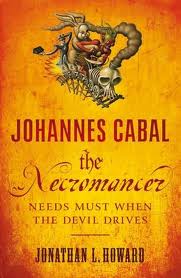
Book Review: Johannes Cabal the Necromancer (2010) by Jonathan L. Howard
Terry Pratchett isn't, unfortunately, going to be writing forever, but Jonathan L. Howard may well be his worthy successor. This is the second Johannes Cabal novel I've read (review here) and it's clear he's more than a one-hit wonder. There are fantasy writers who can come up with imaginative, well-plotted stories, and others who can write comedy, but it's really only Pratchett who's been able to combine the two. Jasper Fforde and Robert Rankin have tried to follow in Pratchett's footsteps, but they just feel like very pale imitations. Howard is the real deal. The key to his success is that he creates solid plots that work as an excellent framework for some very good comedy writing.
In his debut appearance Cabal journeys to Hell to strike a deal with Satan for the return of his soul, which he previously sold for assistance in learning the science of necromancy. Satan tells Cabal he can have his soul back if he provides him with 100 souls as compensation. Cabal agrees to the deal, and Satan lends him a supernatural traveling carnival as a means of ensnaring human souls. Cabal has one year in which to acquire 100 signed contracts from people who are willing to give up their souls to Satan in return for earthly power and delights.
The carnival and the deal with the Devil are handy plot devices for Howard to construct a string of supernatural and comedic set pieces around. With a lesser writer this plot structure might have felt clunky, but Howard gives his story a nice flow, smartly alternating scenes that are spooky with ones that are comic. No two stops the carnival makes play out the same way, and it serves one of Howard's strengths as a writer. In Johannes Cabal the Detective the novel ends with an epilogue that also works as an excellent standalone horror short story. In Necromancer Howard's ability as a short story writer comes in very handy as each stop the carnival makes creates an opportunity for a separate story. Not every stage on the journey has a short story attached, but when Howard does turns his hand to one the results are excellent. The standout in this regard is a chapter that's both a neatly constructed story with a sting in its tale, and also a pitch-perfect homage to the Nigel Molesworth books by Geoffrey Willans.
Having read two of the Cabal books it's clear that Howard is also very good at writing about the supernatural. In Detective he tried his hand at Lovecraftian horror, and in Necromancer he gives us a more traditional ghost story that comes from the M.R. James school. The humour, both in tone and style, is what's most Pratchett-like about Howard. In fact, Pratchett's Discworld novel Eric seems to have inspired the opening section of Necromancer. The only minor drawback to the Cabal novels is Cabal himself. He's Blackadder in necromancer's clothing, and while that works well for comic purposes, after a certain point his constant, and sometimes cruel, self-centredness becomes a bit tiresome. There needs to be more variety in his character. And here's one last quibble: Howard needs to decide what time period the Cabal stories are set in. This one seems to be set in the 1930s, but the next, Detective, feels like it's set in the Edwardian era.
Tuesday, July 19, 2011
Book Review: Space Captain Smith (2008) by Toby Frost
If you made a guess based on the cover of this book that what awaits you is something seriously silly, you'd have guessed right. What we have here is a ripping yarn (sci-fi division, steampunk regiment) about an army officer named Isambard Smith who proudly serves the British Space Empire in the 25th century. His sidekicks are Polly, an android sex toy and pilot of Smith's ship the John Pym, and Suruk the Slayer, a bloodthirsty alien warrior and Smith's best friend. In this, Smith's first adventure, he must find and protect Rhianna Mitchell, a hippie with special powers. Smith is protecting her from the Ghast Empire, an evil civilization of ants bent on destroying the British Space Empire. Smith, a two-fisted, less dim version of Bertie Wooster, muddles his way to success and gives the Ghast a damn good thrashing.
But enough about the plot. The success or failure of a comic novel is almost entirely dependent, from the reader's perspective, on the quality of the comedy, not the plotting; P.G. Wodehouse's plots weren't especially clever or original, but that doesn't detract from his position as arguably the greatest writer of English comic fiction. The benchmark for comic writing in the sci-fi/fantasy world is, of course, Terry Pratchett, and on the Pratchett-o-meter Frost scores a very healthy 8.5 out of 10.
Frost, like Pratchett, loves to lampoon popular culture, drop in literary references and quotations, and forge some really diabolical puns. Frost is particularly keen on referencing movies, and there's one especially clever bit in the book built around A Clockwork Orange, not to mention comic riffs on Blade Runner, The Matrix, and even, I think, The Wild Bunch. And Smith's friend Suruk is very clearly modeled on the alien nasty from Predator. Frost's riffs on pop culture are great fun, but the guy can also craft a really clever comic sentence. Here's Smith complaining to a superior about not getting a spaceship to command:
"You know jolly well that I'd eat my own pants for a chance to get back into space, and yet here I am, still sitting here, wearing them."
Wodehouse himself would have been happy to have penned that sentence. Frost is definitely a very funny writer. What holds him back from Level Pratchett are some double entendres that are a bit too Carry On-ish, and an occasional failure to hold back from making the obvious joke. I will definitely read the rest of the books in this series, God Emperor of Didcot and Wrath of the Lemming Men.
Subscribe to:
Posts (Atom)