Showing posts with label Jonathan L. Howard. Show all posts

Monday, October 31, 2016

Book Review: The Fall of the House of Cabal (2016) by Jonathan L. Howard

Let's play sports analogies: In the field of fantasy/horror fiction, Jonathan L. Howard is a decathlete who regularly ends up on the podium. He's a 20-game winning pitcher who can paint the corners with the fastball, freeze batters with his curveball, and make them look foolish with the breaking ball. He's a centre in hockey who plays a 200-foot game and can be counted on for some Gordie Howe hat tricks every season. And now I've run out of sports I know anything about. My point, and I do have one, is that Howard is a writer who, within his particular field, is adept at any literary style you care to think of. Depending on what's called for, or as the mood takes him, he can do comedy (high and low), horror, big action set-pieces, mystery, wit, spookiness, and good old-fashioned ripping yarn adventure. His masterful skill as a literary shape-shifter is always most evident in his Cabal books, of which this is the fifth in the series.

This time out Johannes and his brother Horst are on the hunt for the Fountain of Youth. To get there they require the assistance of three women: a spider demon, a witch, and a detective. The Cabal novels take place in a steampunky Europe that looks and sounds roughly like the 1920s. Cabal & Co. journey to several supernatural realms, fight everything from ghouls to vampiric bankers to Satan himself, and it's all done with style and effervescent inventiveness. That description might make it sound like the author has overegged his pudding (a common fault in the steampunk genre), but Howard is disciplined enough to never introduce a new story element without giving it the proper level of development and creative attention. 

What might be most striking about this latest entry in the Cabal franchise is that it still holds the reader's attention. The woods are full of fantasy writers who crank out trilogies, quartets, and quintets, but it's rare for any of these shelf-fillers to maintain a high standard beyond the first in the series. The Cabal books are consistently excellent. One reason for this is that Howard dabbles in a different type of story with each outing. The series has included a mystery story, a picaresque adventure set in a carnival, a Lovecraftian epic, and a war story of sorts. The other factor that accounts for the longevity of the series is that Howard brought in Horst to be a foil for Johannes. Horst is a vampire with a heart of gold, and his geniality, humour and humanity act to leaven the sardonic misanthropy of Johannes. 

You don't have to be a fantasy/horror fan to enjoy this series. Howard's main aim is to amuse, and what stands out most strongly about the Cabal books is their wit. There are lots of things that go bump, slither, and bite in the night, but the overall tone is comic with a generous side order of rip-roaring adventure. The humour is often acidic, the writing sometimes donnish and orotund (I sense the ghost of mystery writer Michael Innes is present here), and there is absolutely never a dull moment. And here's hoping Horst Cabal gets a standalone novel in the Cabal universe. 

Thursday, December 3, 2015

Bite-Sized Bad Books

These days it seems that for every good book I read, I have to start, and abandon, at least one dud. I can't be bothered to do full reviews of every turkey I come across, so here are three mini-reviews of two books I gave up on, and one that I ended up skim-reading. Consider yourself warned.

Carter & Lovecraft (2015) by Jonathan L. Howard

You wouldn't hire a bespoke tailor to run you up a pair of board shorts and a T-shirt, so why was Howard, the author of the excellent series of Johannes Cabal novels (my review), commissioned to write this tie-in novel for an upcoming TV series? The premise is that a descendant of horror writer H.P. Lovecraft teams up with an ex-NYPD cop to fight supernatural baddies of the Lovecraftian variety. Howard is an excellent writer with an amazing ability to meld steampunk, horror and humour, and he does so with fluid, smart prose and a lot of originality. In Carter & Lovecraft, Howard takes all of his strengths as a writer and tosses them out in favour of a narrative voice that's supposed to sound American, but comes across as second-rate Lee Child. The story is slow, the American setting is poorly realized (Howard is a Brit), the dialogue and banter between the main characters is awkward, and the horror, by the time I abandoned the book at the one-third mark, consisted of one mildly unpleasant death. I hope they paid Howard well, but he should have used a pen name. He has a reputation to protect.

The Color of Smoke (1975) by Menyhert Lakatos

The first English translation of this "epic novel of the Roma" came out in August of this year, and I was intrigued because I've never read anything fictional about the Roma, let alone a novel written by a Roma author. Turns out Lakatos has nothing good to say about his own people. The novel is set just before World War Two in Hungary in a rural community of Roma. Lakatos is unsparing, even savage, in describing the backwardness and brutality of life in this world. In fact, by the halfway point it seemed the book's only purpose was to take vicious swings at the Roma. Lakatos is a good writer but I could only stomach so many descriptions of rural poverty and the abuse of women.


The Road to Little Dribbling (2015) by Bill Bryson

I'll take it on faith that Bill Bryson actually went to the places he describes in this rambling tour around Great Britain. On the other hand it's entirely possible that he sat down in front of his laptop and created this travel book entirely through the generous use of Wikipedia, Google Earth, the Oxford Dictionary of National Biography, and Tripadvisor. And he does, in fact, frequently quote from these sources. Here's the book's formula: Bill travels to a British town or point of interest (Stonehenge, the South Downs, etc.) and lists the local shops, tours a museum and describes its contents, throws in a bit of history culled from the internet, complains about litter/rudeness/various bureaucratic inefficiencies, makes a humorous observation or two, throws in some invented comic dialogue between himself and a local, and then ambles off to his next destination. And he even steals a gag from one of Eddie Izzard's routines. I skim-read my way through this one, marveling that apparently the most successful authors are now allowed to plagiarize their books from the web. It's cheaper than hiring a ghost writer, I suppose.

Thursday, June 13, 2013

Book Review: Scrivener's Moon (2011) by Philip Reeve

With this, the third and concluding(?) prequel to the four volume Mortal Engines series, Philip Reeve has created what has to be the gold standard in steampunk literature. Or perhaps I should say the brass standard. One of Reeve's best attributes as a steampunk writer is that he's not self-conscious about it. The seven novels in his imagined world aren't overly barnacled with the bling of steampunk, such as quirky, Victorian-themed nomenclature; heroes and heroines who are more ripping yarn archetypes than real characters; cameos from famous individuals, both real and fictional; and an obsession with all things that produce steam and smoke and are covered in brass. Reeve reverse engineers his novels, as it were, by starting with some dazzling creative concepts, adding in clever plots, and finishing off with well-rounded characters. With those building blocks in place the steampunk elements are never made to feel like the main attraction. Too many writers make the window dressing of steampunk the entire purpose of their novel.

Scrivener's Moon, which is set in the far, post-apocalyptic future, finishes the story of Fever Crumb, a teenage girl who's witness to the birth of London as a mobile, heavily armed city. It's almost impossible to do a synopsis of the story without launching into a lengthy outline of all seven volumes, but rest assured that Reeve's skill and imagination are undiminished in what might be his final outing in this genre. What's particularly pleasing is that his sense of humor remains intact. The term "post-apocalyptic" doesn't usually go hand in hand with humor, but Reeve knows that a largely grim story needs a bit of balance, and his sharp wit provides that contrast. And bonus marks for the subtle and natural way in which he shows Fever discovering that she's gay.

And now for a word about steampunk. There are endless, geeky arguments about what steampunk is or isn't, but my simple but comprehensive theory is that a steampunk novel is always set in either an old-fashioned future or a futuristic past. So there. This unruly bastard child of SF and the traditional adventure novel has attracted a lot of top-notch writers. Reeve, Nick Harkaway, Jonathan L. Howard and Toby Frost have all produced highly original, funny and exciting novels in the genre. What they all have in common, aside from talent, is that they're all British. Coincidence? I think not. I have a theory that the present dominance of UK writers in the steampunk field can be traced to TV shows like Dr Who, The Avengers, Quatermass, and all those Supermarionation shows such as Thunderbirds. The commonality in these programs is that anything goes, imaginatively speaking. Those shows mixed and matched all kinds of plots, characters and genres in the name of adventure and humor. Dr Who and The Avengers were particularly gleeful and energetic in this regard, and both were among the most popular and long-lasting shows of the 1960s and '70s. Today's steampunk writers grew up on those shows and I think it's fair to say that their ability to synthesize disparate genres into coherent, gripping stories owes a lot to Steed, Mrs Peel, the Doctor, and Captain Scarlet.

Tuesday, May 8, 2012

Book Review: Johannes Cabal the Fear Institute (2011) by Jonathan L. Howard

In the two previous Johannes Cabal novels (my reviews here and here) author Jonathan L. Howard tried his hand at a steampunk adventure and a tale about a demonic circus which combined elements from Terry Pratchett and M.R. James. In his latest novel Howard goes the full eldritch and worships at the unholy temple of H.P. Lovecraft. He does it brilliantly; in fact, better than H.P. ever did.

The story this time out has necromancer Cabal hired by the Fear Institute, a secret organization sworn to eliminate fear from the hearts of men. How to do this? By journeying to the Dreamlands, where dreams come to life, and slaying the Phobic Animus, the begetter of fear. The members of the Fear Institute believe a new Golden Age can be achieved if Man is no longer shackled by fear. Cabal accepts the job, and he and three members of the Institute go to the Dreamlands and, naturally enough, discover all manner of horrors and terrors. What fun!

I won't bother with plot details, but suffice to say that Howard constructs a fascinating, entertaining story that always maintains a very high level of imagination, excitement and invention. Howard is simply a great storyteller and a clever writer, and his talent would shine out in any genre, but he shines even brighter in the fantasy/horror world, a place that seems to have more than its fair share of hacks. It's also praiseworthy that Howard sets out to create a homage to Lovecraft but doesn't let that get in the way of his storytelling. When writers decide to write a homage or pastiche it's usually a way of papering over their own lack of originality. The horror/fantasy genre is stuffed with writers who've been "inspired" by Lovecraft, Pratchett and, of course, Tolkien, and they produce a lot of second-rate material. Howard succeeds in his homage because he uses Lovecraft as a flavouring rather than as the main ingredient.

Lovecraft was famous for his firm yet repulsive handshake.
The appeal of Lovecraft (1890-1937) for horror writers is understandable because he was the popularizer of a new kind of horror story. The vast majority of pre-Lovecraft horror stories were about ghosts, with the occasional werewolf or vampire thrown in for variety. Lovecraft created a literary world of cosmic terrors, hideous gods and creatures who weren't satisfied with merely killing you; they wanted to extract your soul, play with it, nibble on it, use it as a ping-pong ball, shred it into confetti, and then lather, rinse, repeat with it. Lovecraft had a feverish imagination and writing style that's entertaining in small doses. The problem with Lovecraft is that he really only knew how to write one kind of story, but at least he did it with a lot of energy and colour.

I say that Lovecraft was a popularizer because the real father of cosmic horror was William Hope Hodgson (1877-1918), an English writer who Lovecraft cited as an influence. Hodgson's life and writing career was cut short by an artillery shell during WW I, but prior to the war he produced short stories and novels that redefined what a horror story was. His finest novel is The House on the Borderland, which is virtually a template for much of Lovecraft's fiction. Hodgson also wrote some great short stories, including a whole series about Carnaki, a Sherlockian sleuth of the supernatural. Carnaki's name is ridiculous, making him sound like a  second-class magician operating on Brighton Pier, but his adventures are wonderfully strange.

The only problem I have with the Cabal books is Cabal himself. He's a more black-hearted version of Blackadder, and that's amusing up to a point, but towards the end of each novel I keep hoping/expecting there will be some change in his character. It never happens. Cabal is entertaining, but his misanthropic sarcasm has become a one-note joke after three books. More variety, please.

Thursday, March 1, 2012

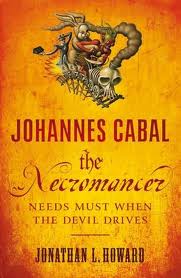
Book Review: Johannes Cabal the Necromancer (2010) by Jonathan L. Howard

Terry Pratchett isn't, unfortunately, going to be writing forever, but Jonathan L. Howard may well be his worthy successor. This is the second Johannes Cabal novel I've read (review here) and it's clear he's more than a one-hit wonder. There are fantasy writers who can come up with imaginative, well-plotted stories, and others who can write comedy, but it's really only Pratchett who's been able to combine the two. Jasper Fforde and Robert Rankin have tried to follow in Pratchett's footsteps, but they just feel like very pale imitations. Howard is the real deal. The key to his success is that he creates solid plots that work as an excellent framework for some very good comedy writing.

In his debut appearance Cabal journeys to Hell to strike a deal with Satan for the return of his soul, which he previously sold for assistance in learning the science of necromancy. Satan tells Cabal he can have his soul back if he provides him with 100 souls as compensation. Cabal agrees to the deal, and Satan lends him a supernatural traveling carnival as a means of ensnaring human souls. Cabal has one year in which to acquire 100 signed contracts from people who are willing to give up their souls to Satan in return for earthly power and delights.

The carnival and the deal with the Devil are handy plot devices for Howard to construct a string of supernatural and comedic set pieces around. With a lesser writer this plot structure might have felt clunky, but Howard gives his story a nice flow, smartly alternating scenes that are spooky with ones that are comic. No two stops the carnival makes play out the same way, and it serves one of Howard's strengths as a writer. In Johannes Cabal the Detective the novel ends with an epilogue that also works as an excellent standalone horror short story. In Necromancer Howard's ability as a short story writer comes in very handy as each stop the carnival makes creates an opportunity for a separate story. Not every stage on the journey has a short story attached, but when Howard does turns his hand to one the results are excellent. The standout in this regard is a chapter that's both a neatly constructed story with a sting in its tale, and also a pitch-perfect homage to the Nigel Molesworth books by Geoffrey Willans.

Having read two of the Cabal books it's clear that Howard is also very good at writing about the supernatural. In Detective he tried his hand at Lovecraftian horror, and in Necromancer he gives us a more traditional ghost story that comes from the M.R. James school. The humour, both in tone and style, is what's most Pratchett-like about Howard. In fact, Pratchett's Discworld novel Eric seems to have inspired the opening section of Necromancer. The only minor drawback to the Cabal novels is Cabal himself. He's Blackadder in necromancer's clothing, and while that works well for comic purposes, after a certain point his constant, and sometimes cruel, self-centredness becomes a bit tiresome. There needs to be more variety in his character. And here's one last quibble: Howard needs to decide what time period the Cabal stories are set in. This one seems to be set in the 1930s, but the next, Detective, feels like it's set in the Edwardian era.

Wednesday, January 4, 2012

Book Review: Johannes Cabal, the Detective (2010) by Jonathan L. Howard

Saying that this is a steampunk novel is an almost useless definition. So many literary mash-ups fly the flag of steampunk that it should be a requirement that they come with flowcharts that explain the various influences and homages that make them up. In this case we have a story set in a mostly alternate reality Europe in which the usual eastern European countries are replaced by states called Mirkarvia, Senza, and Katamenia. The time period is, roughly speaking, Edwardian, and the technology features airships (of course) and entomopters, a dragonfly-inspired aircraft. The literary influences include Agatha Christie, H.P. Lovecraft, and boys adventure magazines like Chums. In sum, the usual DNA of a steampunk adventure.

What sets Cabal apart from the common herd of blood and thunder Victoriana steampunk fiction is that Howard clearly set out with a strong story idea before adding in the steampunk elements. And it doesn't hurt that he's a fine writer. Johannes Cabal, the Detective is the second in a series and it manages to mix together a locked room mystery with a spy action-thriller as well as a taste of supernatural horror. It's to Howard's credit that none of these elements feel forced or awkward. Other steampunk writers I've read tend to clutter up the foreground with steampunk set dressing, as it were, and leave the story behind. This novel would work well even if it wasn't set in an alternate historical reality. Really, the steampunk stuff is just a bonus.

This adventure finds Cabal, a necromancer, fleeing Mirkarvia after raising the country's king from the dead (temporarily). He flees to Senza aboard an airship under a false name and then the fun begins. One of the passengers is murdered and Cabal reluctantly takes the case. Much action and intrigue ensues, and the finale features a spectacular airship crash. As action-y as the story is, it's first and foremost a comic novel, with a comic style influenced heavily by Blackadder. Like Blackadder, Cabal is self-centred, vicious, and mostly concerned with saving his own skin. He does have a glimmer of humanity, and it's brought out by Leonie Barrow, his sidekick in this adventure who, I'm guessing, was introduced in the previous book.

There aren't many writers who can mix comedy and adventure this well, and Howard is definitely one of them. He even manages to provide a clever epilogue to the story that works beautifully as a standalone tale of supernatural horror. My only reservation about the novel is that Cabal's resolute nihilism might make him less interesting to follow in successive stories. But I'll take that chance.