Showing posts with label Thunderbolt and Lightfoot. Show all posts

Wednesday, November 21, 2012

Nobody Move, This Is a Post About Heist Films!

Yes, this should be adequate protection for my pog collection.
So a week ago I caught Ocean's Eleven, the Steven Soderbergh version, on TV. I never thought that version or the original were particularly good, but it got me thinking about the whole genre of heist movies. First, I should set out my own definition of what a heist movie is. A heist movie should be about one particular robbery, not a story about a string of robberies. Second, the theft is the work of a team rather than an individual. Third, the item being stolen has to be elaborately protected: lots of guards, motion sensors, lasers, moats, dobermans, and anything else that's pointy or stabby. By my rules films like Heat, Thief and The Friends of Eddie Coyle are not heist movies. There are heists in them, but they're really about the lives of career criminals. In short, a carefully planned robbery and/or getaway is at the heart of any heist movie. Films such as The Italian Job, They Came to Rob Las Vegas, Topkapi, The Bank Job, and, yes, Ocean's Eleven qualify as heist films in my book.

The first thing that strikes me about the heist genre is that it's odd that it even exists. Big heists are something that only exist in the world of fiction. Yes, there is the occasional real-life heist such as the Lufthansa robbery shown in Goodfellas, and over the years various art galleries have been raided, but almost all these affairs have succeeded without much sophistication: windows and doors are smashed in, guards have guns stuck in their faces, and that's the job done. In the case of the Lufthansa robbery all that was needed was access to a key. So if heists, like serial killers, are something that's more common in films than in real life, why does this genre have such an enduring appeal?

One reason is that the structure of the heist story has its roots in folktales. One of the most common motifs in folktales is of the hero who sets out on a quest to steal a golden horde, a magical sword, or a princess. Along the way he befriends men or animals with special skills or powers who later help him achieve his goal. In other words, they're the team that's assembled in every heist film to help carry out the theft. You know the drill: there's the electronics whizz; the explosives expert; the master of disguises; the femme fatale who distracts somebody or other; and so on and so on. So at a deep level heist films tap into our warm and fuzzy memories of fairy tales and legends.

Another interesting aspect of heist films is that they're a relatively new phenomenon. As far as I can figure heist films didn't begin until the 1950s, and the first I can think of is The Killing (1956) by Stanley Kubrick. But why the '50s and not an earlier era? The Depression seemed tailor-made for films about getting rich quick and illegally, but the only rough equivalent at the time were gangster movies, and they were rigorously moral in that the crooks never lived to enjoy their loot. With heist films, the robbers sometimes, but not always, head into the sunset with millions tucked away somewhere safe. In relation to this, one of the key aspects of any heist film is that the thief is the one we're rooting for. Why should we cheer for these guys? A film about a someone breaking into a pharmacy to steal OxyContin won't garner any sympathy for the thief, but if he assembles a team to loot a bank vault or lift a priceless painting we're on his side all the way. On one level this is an example of the Robin Hood syndrome: we enjoy seeing the rich brought low and the little guy get his slice of the pie. I think it also has to do with the rise of the consumer society, which goes a fair way to explaining why the heist genre didn't come into existence until the '50s. One of the characteristics of the post-war affluent society was the celebration of wealth, or at least a craving for the trappings of wealth. Cheering on enterprising criminals is a vicarious way of lusting for riches. It's the imaginative equivalent of buying a lottery ticket, and it harkens back, in yet another way, to folktales about poor farmers' sons winning land and riches through bravery, audacity and cunning. But then there a variety of heist films about rich men or pure adventurers who steal things just for the pleasure of it. The Jokers and The Thomas Crown Affair are examples of this kind of heist film, and I think they endorse my theory that wealth, and the worship of it, is one of the important attractions of heist films.

Christopher Walken, Sean Connery & Martin Balsam in The Anderson Tapes
There's one other angle to heist films that stands out: the role of women in them. In most heist films the hero's romantic or sexual relationships form an important, even essential, part of the story. And these relationships can be roughly categorized according to the type of robbery being undertaken. Films about smash and grab raids, robberies that entail violence and the use of force, these stories usually show women as disposable sexual objects. The heist films that involve the complex and subtle infiltration of a highly secure area often feature a sub-plot that has the criminal hero romancing a woman. In bald terms, the former variety of heist film is about rape, while the latter is about seduction. "Rape" heist films would include Thunderbolt and Lightfoot, The Italian Job and The Anderson Tapes. "Seduction" films would include 11 Harrowhouse, How to Steal a Million and The Thomas Crown Affair. I'll admit I'm not entirely confident in this theory; perhaps I should just say that it's a feeling I have about a lot of heist films.

And now here's my personal list of heist films that are either favourites or little known. Some are linked to full reviews I've done of them.

They Came to Rob Las Vegashttp://www.jettisoncocoon.ca/2011/05/film-review-they-came-to-rob-las-vegas.html (1968): A nasty, clever European production shot in Spain and CA that has more energy and style than any of the Ocean's films.


The League of Gentlemen (1960): Jack Hawkins leads a team of English gentlemen in a raid on a bank. Great character actors, witty script, and a very believable heist.

The Jokershttp://www.jettisoncocoon.ca/2012/11/film-review-jokers-1967.html (1967): More English gentlemen. This time it's two brothers, Michael Crawford and Oliver Reed, who decide to steal the crown jewels just for the fun of it. Slightly dated, but very entertaining.

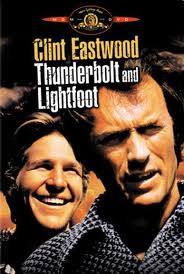
Thunderbolt and Lightfoothttp://www.jettisoncocoon.ca/2012/02/film-review-thunderbolt-and-lightfoot.html (1974): Clint Eastwood and Jeff Bridges rob a bank in Montana in a film that's filled with weird sexual overtones.

Adieu l'Ami (1968): The stars are Charles Bronson and Alain Delon, but the real attraction is the script by Sebastian Japrisot, the crown prince of devious, improbable plots. This film's also called Honor Among Thieves.

The Anderson Tapeshttp://www.jettisoncocoon.ca/2012/05/film-review-anderson-tapes-1971.html (1971): Sean Connery and his gang pillage an exclusive New York apartment building. Directed by Sidney Lumet, it's one of the best crime films of the 1970s.

Wednesday, February 22, 2012

Film Review: Thunderbolt and Lightfoot (1974)

In 1974 I was 17 and only one year away from being legally eligible to see the R-rated Thunderbolt and Lightfoot in the theatre. It was a film I wanted to see very badly because it offered the combination of Clint Eastwood, violence and female nudity. My peers and I all tried to get in to see it, and we all failed. Theatres in Winnipeg took R-ratings very seriously. I finally saw it maybe 5 or 6 years later and thought it was pretty damn cool, just what I was hoping for.

I saw it again this past week and have to revise my opinion somewhat. While in most respects it remains a typical example of 1970s action movies, there are some odd angles to it that are worth a second look. The first is the bromance between Clint Eastwood (Thunderbolt) and the much younger Jeff Bridges (Lightfoot). In 1974 bromance was a term that was twenty years away from being invented, but the relationship between the two leads in this film has to be the template for all the movie bromances that followed. The duo meet cute (in action movie terms), do some bonding over beers and bimbos, and then consummate their relationship with a bank robbery in Montana. What's a bit different about this bromance is that Thunderbolt and Lightfoot are so visibly taken with each other. They do everything but exchange friendship rings. There isn't quite a homoerotic vibe to their relationship, but their enthusiasm for each other is a bit odd for the standards of the '70s. Of course, this bromance shouldn't really be a surprise given that the film was written and directed by Michael Cimino. Cimino later did The Deer Hunter, the grand opera of bromances.

Thunderbolt meets the '70s quota for gratuituous female nudity, but it does so with a leering, hairy-palmed awkwardness that makes it feel like Cimino might have penned the script when he was sixteen. What's odder is that sometimes the standard male heterosexual lustfulness spills over into something gayer. In once scene a brutish character played by George Kennedy insists that Lightfoot describe a naked woman he saw that day. Lightfoot teases him with the description and then gives him a mock kiss a la something Bugs Bunny would do to Elmer Fudd. Also, as part of the heist Lightfoot has to dress in drag and attract the sexual attention of a clerk. Another scene has a minor character telling Thunderbolt about a prank he pulled involving sticking his dick in another man's hand. Sometimes you have to wonder what audience Cimino thought he was writing for. And I won't even mention the plentiful use of phallic symbols.

The last major oddity is the ending, which turns what has been a nasty, rude, tough, fun heist film into something sadder and more serious. The heist, as is often the case in films like this, goes badly awry. George Kennedy double-crosses Thunderbolt and Lightfoot, knocking them both out in the process, and putting Lightfoot down with a particularly vicious kick to the head. Kennedy meets a grisly end shortly thereafter and T & L escape. The next day our two penniless heroes are thumbing a ride and come upon $500,000 stashed from a previous robbery of the same bank (it all makes sense in the context of the story) inside a one-room schoolhouse now being used as museum. This looks like a happy ending, but the kick Lightfoot took has caused serious brain damage, and in the last 6 or 7 minutes of the film we see him go from dazed to dopey to partially paralyzed to dead. It's a shocking and bleak twist to the end and it seems to be an oblique commentary on Vietnam. The Thunderbolt character is described at several points as a Korean War hero, and one of the last things Lightfoot says before he dies is that he now feels like a hero because he's finally accomplished something: he pulled off his role in the robbery. Like the Vietnam War, Thunderbolt ends with nothing really accomplished and a dead young man.

Thunderbolt is mostly well-made, with some nice cinematography, brisk action sequences and a scene-stealing performance from Jeff Bridges in one of his earliest roles.The plot has one or two holes, but otherwise Thunderbolt is an entertaining crime flick, albeit one that's a bit odd and pervy, but that only makes it more interesting.