Showing posts with label Woody Allen. Show all posts

Monday, May 5, 2014

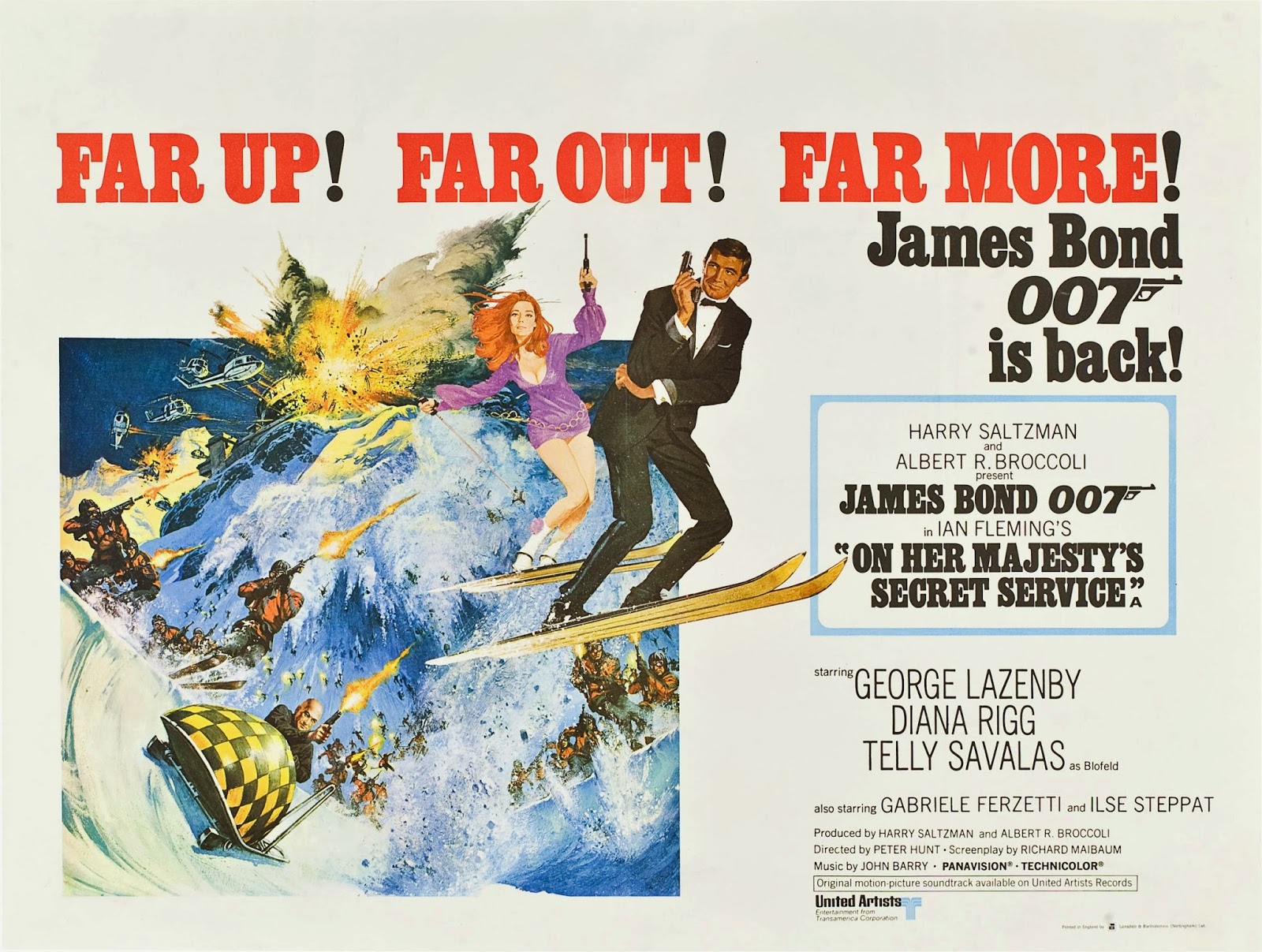
Film Review: On Her Majesty's Secret Service (1969)

I hadn't watched this Bond film since it turned up on TV sometime in the late 1970s, and I remember it as being the worst Bond film ever and that George Lazenby richly deserved the meagre B-movie career (kung fu films, Emmanuelle sequels) he moved onto after his one shot at playing 007. Over the last year or so, however, I've been noticing that various critics and bloggers have been saying that OHMSS isn't really all that bad; in fact, some of them go so far as to say it's one of the best of the 007 films. And then I came across this recent blogpost by director Steven Soderbergh who unflinchingly describes it as the best Bond film, bar none. That did it. I rushed right out (metaphorically speaking) and downloaded OHMSS. Holy crap, Miss Moneypenny! This isn't just a bad Bond film, it's bad filmmaking by any definition, and I can only assume that its defenders are being willfully contrary.

Let's begin the dissection with Lazenby. The pro-OHMSS forces can talk all they want about his physicality, but the fact remains that he can't act, period. Another actor had to dub vast chunks of his dialogue, for God's sake! Lazenby is simply a stiff, awkward (watch him try, and fail, to walk across a room convincingly), wooden black hole at the centre of the film. It's actually a wonder that all his lines didn't end up being dubbed because his readings of even the simplest bits of dialogue are gratingly tone deaf. The legendary Bond quips escape from his lips and simply fall to the floor with a quiet thud, gasping for life. Considering that Lazenby was a male model and had never acted, an infomercial-quality thesping job was pretty much inevitable.

Soderbergh hedges his bets in his praise of OHMSS by saying that "cinematically" it's the best Bond film. I don't think he and I watched the same film. With one exception the editing is shockingly clumsy, creating glaring continuity errors and turning the fight sequences into something resembling the saloon brawls from bad westerns. And many of the action scenes are marred by the use of fast motion, which is used to speed up the action to the detriment of verisimilitude; it's really a kind of cheat, a means to liven up an otherwise flat action scene. On the plus side, the location photography is often spectacular, particularly the shots of the Alps. The final assault on Blofeld's mountaintop H.Q. is actually an excellent combination of action choreography, editing, and cinematography, but this 5-7 minute section hardly makes up for all the wonky filmmaking that surrounds it. I have a feeling that it's this short sequence that moved Soderbergh to call OHMSS "cinematically" the best of the Bonds.

I think even Soderbergh would have to admit that OHMSS's script is a clunker. There isn't one memorable line, and even Diana Rigg (playing Tracy Draco) can't bring things to life until she gets to show off her RADA training by reciting some lines of poetry by James Elroy Flecker, a relatively obscure Victorian poet. I suspect Rigg begged for this scene so she could briefly escape from the tedium of scriptwriter Richard Maibaum's words. Bond films are always sexist, but this one adds an extra level of creepiness with Draco, the father of Rigg's character, urging Bond have sex with her often so that she'll fall in love with him. Thanks, dad, you pervy bastard! Oh, and Tracy gets slapped upside her head by both Bond and her father. Charming. The script is so bland and witless I doubt even Connery could have rescued it, and I'm certain he would never have agreed to be part of the syrupy romantic montage that's used to establish Bond and Tracy's love affair.

So if you haven't seen OHMSS yet, save yourself from the pain and watch the spoof Casino Royale (1967) instead. It's not a lot better, but even Woody Allen makes a better James Bond than Lazenby.

Friday, May 18, 2012

Film Review: The Anderson Tapes (1971)

There are three directors who will be forever identified with New York City. The first two are Martin Scorsese and Woody Allen. The third, and the one with the least name recognition, is Sidney Lumet. Lumet made at least nine films set in NYC, Serpico and Dog Day Afternoon being the most famous, but, unlike Allen and Scorsese, his directorial style is decidedly unidiosyncratic. Lumet, who had a long career in TV before moving to films, had an intense focus on storytelling and he didn't let stylistic flourishes to get in the way of the plot. Lumet's New York films celebrate the city through the faces and voices he cast in his films. The accents and slang of New York fill Lumet's films in a way no other director has matched, and they help give his NYC films an edginess and freneticism that says Gotham like nothing else. He also had an exceptional talent for casting exactly the right actor for each role, right down to the most minor parts. Lumet's fine appreciation for actors also showed in his knack for finding new talent: Christopher Walken, John Cazale, Candice Bergen and Walter Matthau all got their first major roles in Lumet's films.

The Anderson Tapes came just before Serpico and Dog Day Afternoon, and it showcases a lot of Lumet's strengths. The story is about the robbery of a luxurious apartment building bordering Central Park. The leader of the gang, nicknamed Duke, is played by Sean Connery, who, fortunately, does not attempt a New York accent. He is clearly identified early on as being a "limey." Martin Balsam and Christopher Walken (in his first film role) take the other major parts. The robbery does not, of course, go according to plan; for one thing, a baker's dozen of government agencies are surreptitiously bugging most everyone Duke comes in contact with prior to the robbery . In an interesting twist, the robbery section of the film is intercut with flashforwards to the robbery's aftermath. This was pretty cool stuff for 1971, and it adds another layer of tension to the entire sequence.

Lumet's skill at casting is very evident. Every secondary and minor role (there are lots of them) is filled by skilled, experienced character actors, some by name performers like Ralph Meeker and Margaret Hamilton, and others by people who simply have great faces or voices. One example of this is the role of the getaway driver, played by Dick Anthony Williams. His voice and presence grab your attention in every one of the few scenes he's in. A few years later he scored back to back Tony nominations for Best Actor. Lumet really knew how to pick 'em.

The film is shot with Lumet's characteristically unobtrusive, semi-documentary style, and the heist is a superb synthesis of camerawork and editing. The New York locations aren't any of the usual ones, but they look great. A special mention has to go to Quincy Jones' score. It's an amazing mix of jazz/funk that sometimes transitions perfectly into some electronic sound effects that represent a key aspect of the plot. The one aspect of the film that really hits a sour note is Dyan Cannon. Never much of an actress, she provides the eye candy and romance for Connery, but their scenes together are awkward and poorly-written.

Martin Balsam's character is both problematical and significant. He plays a flamboyantly gay interior decorator and his gayness is made fun of at most every opportunity. This was amusing stuff in 1971, but today it looks pretty juvenile. On the other hand, it's important to note that neither Connery's character or the other members of the gang make fun of the Balsam character or even mention his sexuality. To them, he's simply another member of the team. This inclusiveness is striking for the time, and Lumet's sensitivity to gay characters would become even more evident in Dog Day Afternoon.

This isn't one of Lumet's very best films, but it's definitely a fun and energetic example of his directorial skills.

Thursday, October 27, 2011

Film Review: The Seven-Ups (1973)

Philip D'Antoni isn't a name you hear mentioned often when the history of modern cinema is discussed, but he certainly deserves some credit for two notable contributions to film history. The first is the car chase. D'Antoni was the producer of Bullitt, The French Connection, and The Seven-Ups. Now there were certainly car chases before Bullitt, but they were usually done for comic effect as in It's a Mad, Mad, Mad, Mad World, or they were clumsily filmed scenes (lots of rear projection shots) of squad cars chasing bank robbers. In Bullitt and The French Connection the car chase became an action centrepiece, the equivalent of the cavalry charge in westerns and historical epics. D'Antoni's "modern" car chases looked and sounded real, and created a new kind of cinematic excitement. After The French Connection virtually no action film was complete unlesss it included one or more elaborately staged car chases.

D'Antoni's other addition to film history is the creation of a sub-genre I'd call cop noir. Cop noir begins with The French Connection. If film noir was all about doomed lovers, laconic private detectives, and moody cinematography, cop noir was about documenting the decline and fall of American cities and the institutions that make them function as seen through cop eyes. Cop noir looks raw, sounds raw, and shows big American cities torn apart by street crime, organized crime, drug addiction, poverty, and corruption. Hard on the heels of The French Connection came Dirty Harry, Across 110th Street, Busting, Serpico, The Taking of Pelham 123, Badge 373, and a score of similar films. Bullitt isn't cop noir if only because Steve McQueen looks great, acts cool, mostly keeps his temper, and has a supermodel girlfriend before there were supermodels. Compare and contrast with Gene Hackman in The French Connection and you'll see what I mean.

And that brings us to The Seven-Ups. The story has a pre-Jaws Roy Scheider leading a small team of N.Y.C. cops who go after villains wanted for crimes that earn sentences of seven years and up. Why seven years? Because it makes for a punny movie title. The film's title is a dud, but the film isn't. The Seven-Ups is essentially a sequel to Connection in everything but name. It has the same gritty look, Don Ellis scored both films, and it features possibly the best car chase of the three films D'Antoni produced.

The plot has Scheider's team investigating why some of the city's crime bosses are being kidnapped. It turns out Scheider's main snitch, played by Tony Lo Bianco, is using information he gets from an unwitting Scheider to target wealthy criminals for kidnapping and ransom. Things are further complicated by the fact that snitch and cop are childhood friends.Things don't end well for one of them. The story is original and engaging, and might have been even better if D'Antoni hadn't decided to direct this film himself. He had no experience at directing and it shows on occasion. A couple of sequences, notably a scene in a car wash, are clumsily handled and feature a variety of glaring continuity errors.

D'Antoni does redeem himself with the action sequences, which are quick, dirty and efficient, and the car chase, which is certainly as good as the one in Connection as well as being longer. D'Antoni the director also does a nice job with the actors, choosing an all-ugly cast of New York actors who bring a lot of verisimilitude to the film. And New York looks like, well, the New York you don't see in Woody Allen movies. This is Ratso Rizzo's N.Y.C.

If you like to remember New York as being mad, bad and dangerous to visit, check out The Seven-Ups. Spoiler alert: the trailer below shows way too much of the film's highlights.