Showing posts with label Sean Connery. Show all posts

Monday, May 5, 2014

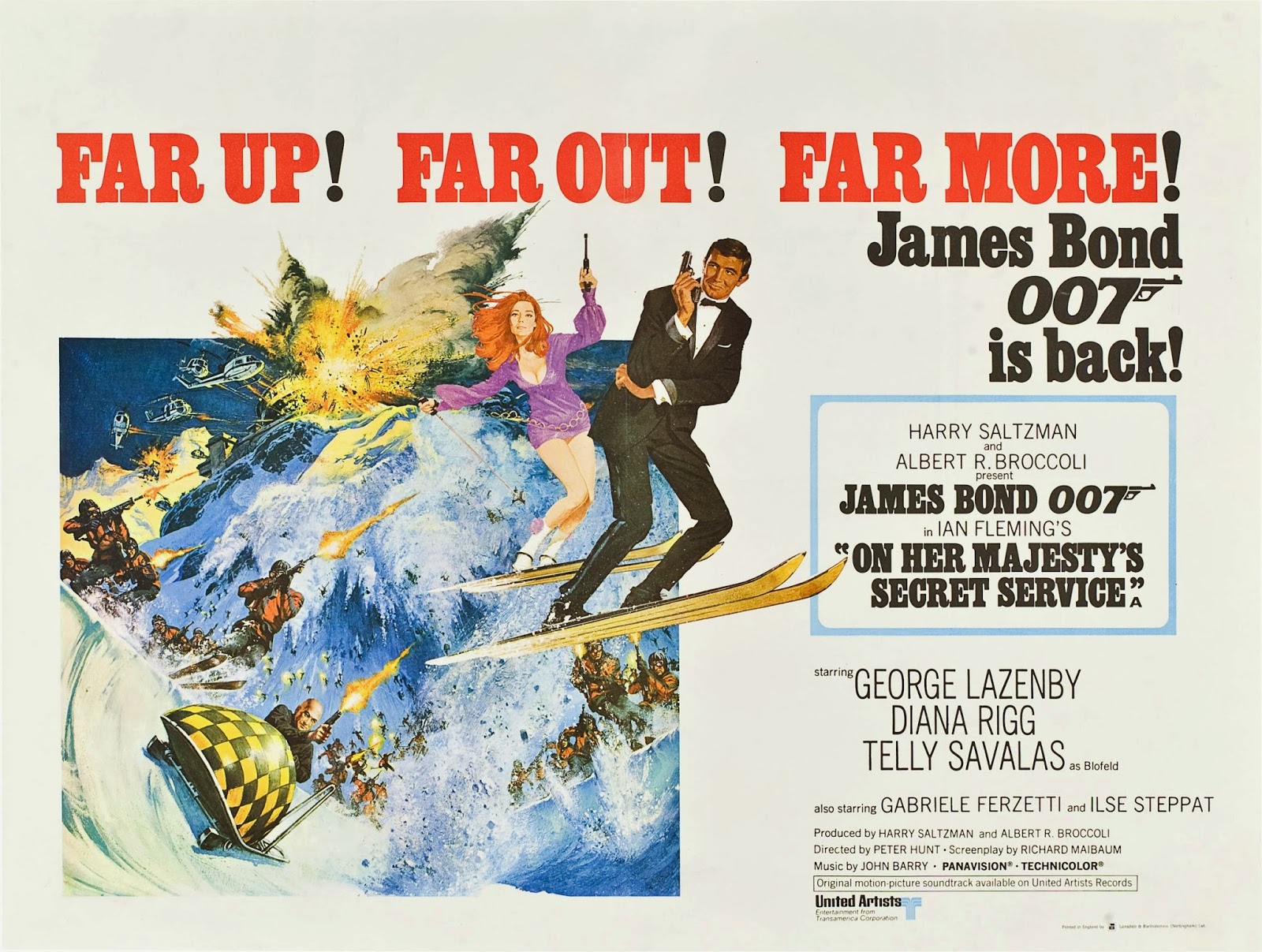
Film Review: On Her Majesty's Secret Service (1969)

I hadn't watched this Bond film since it turned up on TV sometime in the late 1970s, and I remember it as being the worst Bond film ever and that George Lazenby richly deserved the meagre B-movie career (kung fu films, Emmanuelle sequels) he moved onto after his one shot at playing 007. Over the last year or so, however, I've been noticing that various critics and bloggers have been saying that OHMSS isn't really all that bad; in fact, some of them go so far as to say it's one of the best of the 007 films. And then I came across this recent blogpost by director Steven Soderbergh who unflinchingly describes it as the best Bond film, bar none. That did it. I rushed right out (metaphorically speaking) and downloaded OHMSS. Holy crap, Miss Moneypenny! This isn't just a bad Bond film, it's bad filmmaking by any definition, and I can only assume that its defenders are being willfully contrary.

Let's begin the dissection with Lazenby. The pro-OHMSS forces can talk all they want about his physicality, but the fact remains that he can't act, period. Another actor had to dub vast chunks of his dialogue, for God's sake! Lazenby is simply a stiff, awkward (watch him try, and fail, to walk across a room convincingly), wooden black hole at the centre of the film. It's actually a wonder that all his lines didn't end up being dubbed because his readings of even the simplest bits of dialogue are gratingly tone deaf. The legendary Bond quips escape from his lips and simply fall to the floor with a quiet thud, gasping for life. Considering that Lazenby was a male model and had never acted, an infomercial-quality thesping job was pretty much inevitable.

Soderbergh hedges his bets in his praise of OHMSS by saying that "cinematically" it's the best Bond film. I don't think he and I watched the same film. With one exception the editing is shockingly clumsy, creating glaring continuity errors and turning the fight sequences into something resembling the saloon brawls from bad westerns. And many of the action scenes are marred by the use of fast motion, which is used to speed up the action to the detriment of verisimilitude; it's really a kind of cheat, a means to liven up an otherwise flat action scene. On the plus side, the location photography is often spectacular, particularly the shots of the Alps. The final assault on Blofeld's mountaintop H.Q. is actually an excellent combination of action choreography, editing, and cinematography, but this 5-7 minute section hardly makes up for all the wonky filmmaking that surrounds it. I have a feeling that it's this short sequence that moved Soderbergh to call OHMSS "cinematically" the best of the Bonds.

I think even Soderbergh would have to admit that OHMSS's script is a clunker. There isn't one memorable line, and even Diana Rigg (playing Tracy Draco) can't bring things to life until she gets to show off her RADA training by reciting some lines of poetry by James Elroy Flecker, a relatively obscure Victorian poet. I suspect Rigg begged for this scene so she could briefly escape from the tedium of scriptwriter Richard Maibaum's words. Bond films are always sexist, but this one adds an extra level of creepiness with Draco, the father of Rigg's character, urging Bond have sex with her often so that she'll fall in love with him. Thanks, dad, you pervy bastard! Oh, and Tracy gets slapped upside her head by both Bond and her father. Charming. The script is so bland and witless I doubt even Connery could have rescued it, and I'm certain he would never have agreed to be part of the syrupy romantic montage that's used to establish Bond and Tracy's love affair.

So if you haven't seen OHMSS yet, save yourself from the pain and watch the spoof Casino Royale (1967) instead. It's not a lot better, but even Woody Allen makes a better James Bond than Lazenby.

Friday, November 1, 2013

Film Review: Hell Drivers (1957)

Henri-George Clouzot's The Wages of Fear was an instant classic when it came out in 1953. His visually powerful story of desperate men ferrying nitroglycerin over treacherous roads in South America was ultra-tense and drenched in existential despair. A producer in England must have seen it and thought, "Hey, let's move that story to England, make a few changes, and with any luck we can shoot it over the course of a couple of weekends." Hell Drivers is the bastard offspring of Clouzot's film, and while it's far from a classic it's well worth watching and has a jaw-dropping collection of Brit thespians making their initial forays into feature films. More about that later.

Think of this film as the working class, kitchen sink drama version of The Wages of Fear. Stanley Baker plays an ex-con named Tom who's trying to get his life back on the straight and narrow. His prospects are limited so he takes a job driving dump trucks. The job is tough and brutally simple. The drivers truck gravel (called ballast, here) from a pit to a work site and are paid by the load. If they don't haul at least ten loads a day they're fired, and to do that many loads means driving like a maniac. A thug named Red is the semi-official leader of the drivers, and he's promised a reward of a gold cigarette case to anyone who can beat his daily total of runs. This makes each day's work a rally race for the drivers. Over the course of the film Tom and Red butt heads, a romance is ended, a brawl breaks out at a dance, a swindle is uncovered, and the film ends with a truck carrying a major character going over a cliff.

The overall look of Hell Drivers is very raw. The scenery and interiors are bleak, no one dresses well, the drivers take all their meals in a shabby cafe, and even the trucks look like they're one dent away from the junkyard. This is a Britain still recovering from the war and only three years removed from the end of food rationing. The Swinging Sixties, the Beatles, and Carnaby St seem very far away in this universe. Even the scale of the drama is muted. The swindle run by Red and his boss amounts to only a hundred or so pounds a week. And that gold cigarette case? It's worth a measly 200 quid! What the hell could that buy in 1957? Probably one of those small and unreliable British cars like the Morris Marmite or the Vauxhall Skiffle. I think that's what they were called. In sum, this is a film that seems to reflect the convalescent character of a nation recovering from a devastating war.

What makes Hell Drivers of more than passing interest is the cast: Stanley Baker, Patrick McGoohan, Sean Connery, Herbert Lom, Sid James, Gordon Jackson, David McCallum and William Hartnell. There you have the future stars of some of the most iconic film and TV franchises of the 1960s. It seems like a dreadful oversight that Patrick Macnee, Michael Caine and Captain Scarlet weren't also given roles. And the cast certainly does it's bit to distract us from an unambitious plot and scenes of trucks driving "fast" that often look like outtakes from a Keystone Kops film. So here's my suggestion for a thematically linked triple bill: start with The Wages of Fear, then Hell Dirvers, and finish with 1969's The Italian Job for a look at what a brash, confident Britain produced the next time it made a film about reckless driving.

Saturday, March 30, 2013

Film Review: Innocent Bystanders (1972)

Bad movies, like the poor, are always with us. If you think today's big budget craptaculars like the Transformers films are bad, at the very least you have to admit that they're made to a professional standard. This 1972 spy film is a reminder that once upon a time a middling budget genre film could actually get made by people who, based on the evidence at hand, had no idea what they were doing. To be fair that's a bit of an exaggeration. The director, Peter Collinson, did the original The Italian Job, but it stands as a lonely beacon of excellence in a filmography wilderness of rotgut genre pictures.

The plot is a tired bit of boilerplate about a Russian scientist who's defected...everyone wants him...old dog spy given last chance...double-crosses...rinse, lather, repeat. There are holes aplenty in the story, but that's not a deal breaker for this kind of film as long as it's done with style, wit and pugnacity. No such luck. It looks ugly, with cheap sets and some really inept camerawork. And special mention has to go to the decision to have Spain double for Maine, which leads to the novel sight of a car driving through the maquis landscape of New England. The action elements are minimal, and some decent fight scenes don't make up for car chases and shootouts that would look bad even on a TV cop show of the era. And the acting? Stanley Baker, the star of the film, does a workmanlike job, but the rest of the troupe are either miscast or sleepwalk through their roles.

The real tragedy of Innocent Bystanders is that it's a reminder that Stanley Baker never got the big break he deserved. After producing and co-starring in Zulu (my review here), he looked set to join the rising tide of Brit stars like Caine, Finney, and O'Toole. His subsequent films either did no business, were critical duds, or both. Part of the problem was that Baker was a capable, but not great actor, and also that he looked like Sean Connery's stunt double. In fact a lot of his films seem like projects the producers probably wished they could afford to have Connery in, but they had to settle for Stanley. By the way, don't let the cover art on the DVD box (pictured above) fool you: if the film was one-tenth as cool as this it would be worth watching.

Friday, May 18, 2012

Film Review: The Anderson Tapes (1971)

There are three directors who will be forever identified with New York City. The first two are Martin Scorsese and Woody Allen. The third, and the one with the least name recognition, is Sidney Lumet. Lumet made at least nine films set in NYC, Serpico and Dog Day Afternoon being the most famous, but, unlike Allen and Scorsese, his directorial style is decidedly unidiosyncratic. Lumet, who had a long career in TV before moving to films, had an intense focus on storytelling and he didn't let stylistic flourishes to get in the way of the plot. Lumet's New York films celebrate the city through the faces and voices he cast in his films. The accents and slang of New York fill Lumet's films in a way no other director has matched, and they help give his NYC films an edginess and freneticism that says Gotham like nothing else. He also had an exceptional talent for casting exactly the right actor for each role, right down to the most minor parts. Lumet's fine appreciation for actors also showed in his knack for finding new talent: Christopher Walken, John Cazale, Candice Bergen and Walter Matthau all got their first major roles in Lumet's films.

The Anderson Tapes came just before Serpico and Dog Day Afternoon, and it showcases a lot of Lumet's strengths. The story is about the robbery of a luxurious apartment building bordering Central Park. The leader of the gang, nicknamed Duke, is played by Sean Connery, who, fortunately, does not attempt a New York accent. He is clearly identified early on as being a "limey." Martin Balsam and Christopher Walken (in his first film role) take the other major parts. The robbery does not, of course, go according to plan; for one thing, a baker's dozen of government agencies are surreptitiously bugging most everyone Duke comes in contact with prior to the robbery . In an interesting twist, the robbery section of the film is intercut with flashforwards to the robbery's aftermath. This was pretty cool stuff for 1971, and it adds another layer of tension to the entire sequence.

Lumet's skill at casting is very evident. Every secondary and minor role (there are lots of them) is filled by skilled, experienced character actors, some by name performers like Ralph Meeker and Margaret Hamilton, and others by people who simply have great faces or voices. One example of this is the role of the getaway driver, played by Dick Anthony Williams. His voice and presence grab your attention in every one of the few scenes he's in. A few years later he scored back to back Tony nominations for Best Actor. Lumet really knew how to pick 'em.

The film is shot with Lumet's characteristically unobtrusive, semi-documentary style, and the heist is a superb synthesis of camerawork and editing. The New York locations aren't any of the usual ones, but they look great. A special mention has to go to Quincy Jones' score. It's an amazing mix of jazz/funk that sometimes transitions perfectly into some electronic sound effects that represent a key aspect of the plot. The one aspect of the film that really hits a sour note is Dyan Cannon. Never much of an actress, she provides the eye candy and romance for Connery, but their scenes together are awkward and poorly-written.

Martin Balsam's character is both problematical and significant. He plays a flamboyantly gay interior decorator and his gayness is made fun of at most every opportunity. This was amusing stuff in 1971, but today it looks pretty juvenile. On the other hand, it's important to note that neither Connery's character or the other members of the gang make fun of the Balsam character or even mention his sexuality. To them, he's simply another member of the team. This inclusiveness is striking for the time, and Lumet's sensitivity to gay characters would become even more evident in Dog Day Afternoon.

This isn't one of Lumet's very best films, but it's definitely a fun and energetic example of his directorial skills.