If you like your kids' lit to include a bracing dose of class warfare and anarchism, I can't recommend these two novels enough. I actually read them more than twenty years ago, but I recently found out that a third was written in 1986 (The Borribles: Across the Dark Metropolis), which, unfortunately, I haven't been able to find. And how politically feisty are these books? The third volume was held back from publication because Collins, the publisher, felt that the book's anti-police message was too strong in the aftermath of the Brixton riots in London. Pan eventually published the third volume, and all three are now available on Amazon.
Plenty of kids' books have been suppressed because they offended the religious or the squeamish, but not many that I can think of have been frowned upon for their politics. Borribles are kids who've run away from home or are otherwise deemed "unmanageable." In this urban fantasy London such children turn into Borribles. Their "wildness" takes physical form in their pointed ears, which they keep hidden lest they be spotted by the police, their sworn enemies. Borribles live in groups, stealing food and clothing, but spurning material possessions and money. They live in abandoned buildings and London's secret, empty places, and as long as their pointy ear aren't "clipped", they remain children forever. The police are always on the lookout for Borribles. When they catch one, his or her ears are clipped and they start growing up again. It's a fate worse than death for Borribles.
Just from that short synopsis you can see that for an overly sensitive and censorious parent these books offer a laundry list of objectionable elements: approval of theft; scorn for the police; a celebration of life without adults; contempt for consumerism; and an energetic dislike of street-level capitalism. The overall anarchic character of these books is what has made them suspect in the eyes of many, but it also makes them delightful to read. I read them as an adult so I can only imagine how transgressive they would seem to a kid used to earnest do-gooders like Harry Potter.
Don't be worried that the novels are distractingly political. These are adventure stores first and foremost, and Larrabeiti knows his way around a ripping yarn. The first novel has the Borribles in conflict with the Rumbles, a race of mole-like creatures who talk like members of the Drones Club (Borribles have Cockney accents) and are trying to take over Borrible territory. The second novel, as far as I can remember, continues the story and ends in a rather spectacular sequence by a river running underneath London. Sadly, Larrabeiti died in 2008. His obituary, which I've linked here, is well worth reading: his life sounds as interesting as his fiction.
Showing posts with label Harry Potter. Show all posts
Friday, November 23, 2012
Wednesday, February 15, 2012
Book Review: The Mennyms (1993) by Sylvia Waugh
Working at the library has shown me that adult readers are generally reluctant to move outside their preferred genre; mystery readers read only mysteries, romance readers read only romances, and so on. Sometimes they'll make an exception for a high-profile author like Stephen King or a notable bestseller like The Help, but generally most readers stay in their groove. The one genre they rarely make an exception for is kids' lit. Yes, a lot of adults read Harry Potter, but I think that's the exception that proves the rule. And that's a pity because some of the smartest, most imaginative writing can be found in the kids section.
The Mennyms is a perfect example of first-rate writing that should be allowed a place at the grownups' table. I'll admit that the basic story idea of The Mennyms sounds painfully cute, whimsical and juvenile: the Mennyms are an extended family of life-size rag dolls who have, for some mysterious reason, come alive. Through a complicated, but believable, series of subterfuges and stratagems the Mennyms have managed to keep their peculiar existence a secret. They live in a house in a middle-class London suburb that was once owned by their deceased maker, and behind perpetually drawn curtains they try and live their lives as though they were fully human. The Mennyms are completely aware that they aren't human, but engage in meals and so on (what they call "pretends") that fill their day.
On one level the novel is about the Mennyms' attempts to live their lives without being discovered. On another level it's about what constitutes a family, and how various domestic rituals and traditions help bind a family together. And on yet another level it's about the Big Questions: why are we here? Why do we exist? What defines existence? Although the Mennyms are dolls, they all have very human, very real personalities. They're very ordinary, very middle-class "people", but Waugh is such an acute and sensitive writer (she's won a ton of kids' lit awards) that you very soon forget that these characters aren't human. If Barbara Pym or Graham Greene had decided to take a stab at writing for kids or young adults they might have come up with something like this.
The Mennyms is the first in a series of five novels, all of which deal in one way or another with the Mennyms trying to avoid exposure and find out how they came to be. There are moments in this series that are unbearably tense and others that are heartbreaking, so much so that I wonder if kids will be able to deal with them. The last novel of the five isn't as strong as one might hope, but overall this series has to rate as a classic of children's literature.
The Mennyms is a perfect example of first-rate writing that should be allowed a place at the grownups' table. I'll admit that the basic story idea of The Mennyms sounds painfully cute, whimsical and juvenile: the Mennyms are an extended family of life-size rag dolls who have, for some mysterious reason, come alive. Through a complicated, but believable, series of subterfuges and stratagems the Mennyms have managed to keep their peculiar existence a secret. They live in a house in a middle-class London suburb that was once owned by their deceased maker, and behind perpetually drawn curtains they try and live their lives as though they were fully human. The Mennyms are completely aware that they aren't human, but engage in meals and so on (what they call "pretends") that fill their day.
On one level the novel is about the Mennyms' attempts to live their lives without being discovered. On another level it's about what constitutes a family, and how various domestic rituals and traditions help bind a family together. And on yet another level it's about the Big Questions: why are we here? Why do we exist? What defines existence? Although the Mennyms are dolls, they all have very human, very real personalities. They're very ordinary, very middle-class "people", but Waugh is such an acute and sensitive writer (she's won a ton of kids' lit awards) that you very soon forget that these characters aren't human. If Barbara Pym or Graham Greene had decided to take a stab at writing for kids or young adults they might have come up with something like this.
The Mennyms is the first in a series of five novels, all of which deal in one way or another with the Mennyms trying to avoid exposure and find out how they came to be. There are moments in this series that are unbearably tense and others that are heartbreaking, so much so that I wonder if kids will be able to deal with them. The last novel of the five isn't as strong as one might hope, but overall this series has to rate as a classic of children's literature.
Friday, December 2, 2011
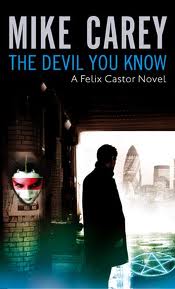
Book Review: The Devil You Know (2006) by Mike Carey
This supernatural thriller/murder mystery is remarkably similar to Rivers of London, a novel I reviewed exactly a month ago. Both novels offer an alternative reality version of London in which ghosts and various supernatural baddies plague the general citizenry. Rivers had a cop/wizard as its hero, while this novel has a freelance exorcist named Felix Castor taking top billing.
Felix specializes in ridding homes and businesses of ghosts. The ghosts in London are just your common or garden variety ghosts, and there are lots of them, but their ordinariness doesn't stop them from scaring the crap out of Londoners, and that's where Castor comes in. He exorcises ghosts with the aid of a tin whistle; he essentially "whistles" them out of existence. That sounds silly, but Carey doesn't an excellent job of making the magical elements in his alternate world feel believable. In relation to this, he also does a great job of what's known in fantasy writing as "world-building." Carey's London is gritty, detailed, and the supernatural elements fit quite smoothly into this milieu. In this story Castor investigates a ghost haunting an archive in central London. He also has to deal with a murderous vice lord with a zombie henchman, and a succubus who wants his soul.
Castor's job title is exorcist, but he's basically a gumshoe: Philip Marlowe in everything but name. And take away the ghosts and demons, and the plot of The Devil You Know is pure hardboiled murder mystery. Castor gets slapped around, cracks wise, and can't resist a damsel (or ghost) in distress. The problem with the plot is that it goes on and on and on. The final quarter of the story, when things should be speeding up, feels bogged down with lengthy background stories and explanatory passages. Devil isn't lardy and prolix the way the final Harry Potter books were, but it definitely would have benefited from some pruning.
Putting aside the plot problems, this is a very entertaining read. The supernatural bits have a visceral thrill, and the characterization is much better than average. In these respects Devil is superior to Rivers of London. Where the latter scores better is the plot, which was lean and efficient, albeit a bit shambolic towards the end. This is the first of six Felix Castor adventures, and I'll definitely give the next one a try.
Felix specializes in ridding homes and businesses of ghosts. The ghosts in London are just your common or garden variety ghosts, and there are lots of them, but their ordinariness doesn't stop them from scaring the crap out of Londoners, and that's where Castor comes in. He exorcises ghosts with the aid of a tin whistle; he essentially "whistles" them out of existence. That sounds silly, but Carey doesn't an excellent job of making the magical elements in his alternate world feel believable. In relation to this, he also does a great job of what's known in fantasy writing as "world-building." Carey's London is gritty, detailed, and the supernatural elements fit quite smoothly into this milieu. In this story Castor investigates a ghost haunting an archive in central London. He also has to deal with a murderous vice lord with a zombie henchman, and a succubus who wants his soul.
Castor's job title is exorcist, but he's basically a gumshoe: Philip Marlowe in everything but name. And take away the ghosts and demons, and the plot of The Devil You Know is pure hardboiled murder mystery. Castor gets slapped around, cracks wise, and can't resist a damsel (or ghost) in distress. The problem with the plot is that it goes on and on and on. The final quarter of the story, when things should be speeding up, feels bogged down with lengthy background stories and explanatory passages. Devil isn't lardy and prolix the way the final Harry Potter books were, but it definitely would have benefited from some pruning.
Putting aside the plot problems, this is a very entertaining read. The supernatural bits have a visceral thrill, and the characterization is much better than average. In these respects Devil is superior to Rivers of London. Where the latter scores better is the plot, which was lean and efficient, albeit a bit shambolic towards the end. This is the first of six Felix Castor adventures, and I'll definitely give the next one a try.
Wednesday, November 2, 2011
Book Review: Rivers of London (2011) by Ben Aaronovitch
Right now the book world is awash in fantasy literature. This is largely thanks to the twin aftershocks of Harry Potter and the Twilight books. Anything, it seems, with a fantasy or horror element, and any mash-up entangling the two with other genres, gets a warm greeting from the publishing industry. This has produced a lot of dreck, usually involving Buffy clones finding romance as they splatter the undead.
Rivers of London avoids zombies and romance, and is mostly successful, largely thanks to some solid comic writing and a clever mash-up of a police procedural and the world of magic. Our hero is Peter Grant, a young police constable who looks to be headed for a dull, behind-the-scenes job in the Met. All that changes when he's assigned to guard a crime scene involving a headless corpse and then ends up taking a witness statement from a ghost. From there it's a short step to becoming an apprentice wizard under the tutelage of Chief Inspector Thomas Nightingale, who is, yes, a fully-fledged wizard. Nightingale's remit, which is known only to a few of his superiors, is to investigate supernatural crimes and keep the peace on the otherworldly side of London.
The headless corpse is the first in a series of gruesome deaths perpetrated by a vengeful ghost who is using the bodies of Londoners to reenact a bizarre and bloody Punch and Judy show. On top of trying to collar the murderous ghost, Grant and Nightingale have to keep the peace between the gods of London's rivers. London apparently has many rivers, mostly hidden, but each has it's god, and Mother Thames and Father Thames rule over them all.
Aaronovitch has a slick, chirpy writing style that owes a lot to Terry Pratchett, and he's smart enough to have Grant make a couple of references to Harry Potter just so we know that Grant realizes he's dropped into an absurd and improbable world. Aaronovitch also does a good job of explaining, or creating a theory of, how magic works. This is always a bit of a problem in books about magic; the authors either ignore the how and why, or they come up with a dopey, New Age-y explanation. Aaronovitch takes a more technical approach, and it works rather well. Even better is his decision to make the cop elements as real as possible. Take away the magical element and this would be a solid police procedural mystery; Grant talks like a cop, he follows Met protocol, he relies as much on police equipment as he does on magic, and he really seems to enjoy being a policeman.
Where Aaronovitch runs into trouble is with the plot. The final section of the book is a bit of a mess. The first problem is that the author begins to tie himself into thick, confusing knots explaining the magical and supernatural logic behind what's happening. Another bad decision is to have a climactic scene set in a packed Royal Opera House in which the killer ghost reveals himself and a massive riot breaks out. The problem is that this isn't the finale of the book. The riot ends, the reader's excitement evaporates, and the real end comes a short time later. The opera house scene is very Pratchettesque, but Sir Terry would have ended the novel right there.
Notice something? I haven't mentioned the river gods when discussing the killer ghost plot. That's because Aaronovitch fails to make the two plots intertwine in any meaningful way. That would be fine if the river gods' story was a sub-plot, but it isn't. A big chunk of the novel is devoted to dealing with the various gods and, while all of it is interesting and clever, it really doesn't have a damn thing to do with the main plot. The river gods need their own novel, not a superfluous role in a ghostly murder mystery.
There's a sequel to Rivers of London called Moon Over Soho (werewolves, I expect), and yet another is in the pipeline. I'll definitely read the next one and hope that the author has let an editor get a look at it first.
Rivers of London avoids zombies and romance, and is mostly successful, largely thanks to some solid comic writing and a clever mash-up of a police procedural and the world of magic. Our hero is Peter Grant, a young police constable who looks to be headed for a dull, behind-the-scenes job in the Met. All that changes when he's assigned to guard a crime scene involving a headless corpse and then ends up taking a witness statement from a ghost. From there it's a short step to becoming an apprentice wizard under the tutelage of Chief Inspector Thomas Nightingale, who is, yes, a fully-fledged wizard. Nightingale's remit, which is known only to a few of his superiors, is to investigate supernatural crimes and keep the peace on the otherworldly side of London.
The headless corpse is the first in a series of gruesome deaths perpetrated by a vengeful ghost who is using the bodies of Londoners to reenact a bizarre and bloody Punch and Judy show. On top of trying to collar the murderous ghost, Grant and Nightingale have to keep the peace between the gods of London's rivers. London apparently has many rivers, mostly hidden, but each has it's god, and Mother Thames and Father Thames rule over them all.
Aaronovitch has a slick, chirpy writing style that owes a lot to Terry Pratchett, and he's smart enough to have Grant make a couple of references to Harry Potter just so we know that Grant realizes he's dropped into an absurd and improbable world. Aaronovitch also does a good job of explaining, or creating a theory of, how magic works. This is always a bit of a problem in books about magic; the authors either ignore the how and why, or they come up with a dopey, New Age-y explanation. Aaronovitch takes a more technical approach, and it works rather well. Even better is his decision to make the cop elements as real as possible. Take away the magical element and this would be a solid police procedural mystery; Grant talks like a cop, he follows Met protocol, he relies as much on police equipment as he does on magic, and he really seems to enjoy being a policeman.
Where Aaronovitch runs into trouble is with the plot. The final section of the book is a bit of a mess. The first problem is that the author begins to tie himself into thick, confusing knots explaining the magical and supernatural logic behind what's happening. Another bad decision is to have a climactic scene set in a packed Royal Opera House in which the killer ghost reveals himself and a massive riot breaks out. The problem is that this isn't the finale of the book. The riot ends, the reader's excitement evaporates, and the real end comes a short time later. The opera house scene is very Pratchettesque, but Sir Terry would have ended the novel right there.
Notice something? I haven't mentioned the river gods when discussing the killer ghost plot. That's because Aaronovitch fails to make the two plots intertwine in any meaningful way. That would be fine if the river gods' story was a sub-plot, but it isn't. A big chunk of the novel is devoted to dealing with the various gods and, while all of it is interesting and clever, it really doesn't have a damn thing to do with the main plot. The river gods need their own novel, not a superfluous role in a ghostly murder mystery.
There's a sequel to Rivers of London called Moon Over Soho (werewolves, I expect), and yet another is in the pipeline. I'll definitely read the next one and hope that the author has let an editor get a look at it first.
Subscribe to:
Posts (Atom)