Once again the French are showing the rest of the world how to make a thriller. In the last year I've seen Point Blank (review here) and Chamber of Death (review here); both were superb French thrillers. The Prey is not quite up to their level, but it's very, very good. What French thrillers lack in budget they more than make up for in plot. Prey artfully combines a prison drama, a man on the run thriller, and a hunt for a serial killer. This layering of plots was done spectacularly in Chamber of Death, and is a hallmark of Sebastien Japrisot, a French mystery/thriller writer whose novels and screenplays always featured ultra-devious plots. It could be that this is simply a characteristic of French culture. Nineteenth-century French novels are often wall-to-wall with schemes and schemers. One I reviewed recently called The Black Sheep by Balzac represented the gold standard in twisty plotting. In fact, the French should have an award for depictions of scheming in the arts and it should be called the Grand Prix de Cesar et Ugolin, in honour of the conniving peasants in Jean de Florette and Manon of the Spring.
But back to the movie. In Prey, the main character is Franck, an imprisoned bank robber. He's only a few months away from getting out and collecting the two million euros he has stashed from his last robbery. The problem is that his criminal partner wants to know where the money is right now. So does Franck's wife, who has their daughter to support and is having trouble making ends meet. Franck also finds himself reluctantly protecting his wimpy cellmate, a man apparently wrongfully accused of attacking a teenage girl. Franck refuses to tell anyone where the money is. He trusts no one, not even his wife. Franck becomes a wanted man in prison and when a opportunity presents itself he escapes. And here's where things get complicated. I won't let slip any spoilers, but let's just say that Franck has to run for his life and freedom while at the same time tracking down a serial killer.
A lot of the pleasure in this film comes from watching how the script manages to juggle different characters and plot elements and have them all come together in the end in a very satisfying way. You have to admire the skill that went into crafting this story. The film doesn't stint on the action, either. There are beaucoup chases, fights and gunplay, and the finale is a literal cliffhanger. The only weaknesses in the film are a couple of so-so performances by actors in secondary roles and some moments in the action sequences that just don't work. Albert Dupontel plays Franck and certainly looks the part of a hard-bitten con. Dupontel was also in A Very Long Engagement, written, of course, by Sebastien Japrisot.
If you're trying to track this film down beware of a similarly-titled French film called Proie. It was complete crap. This one's French title is La Proie, and it's well worth hunting down.
The one and only reason Hollywood buys up the remake rights to foreign films such as L'appartement, The Departed, Cell 211, Lake Mungoand this one is that they all have rock solid scripts. These are films that start with clever, original concepts and carry through with polished, smart scriptwriting. Hollywood is, in effect, buying the blueprints for success. This begs the eternal question of why filmmakers outside the U.S. seem to be so much better at coming up with original ideas for films. The answer is money.
In lieu of creativity Hollywood has money. A film such as Cowboys & Aliens uses pricey stars, expensive sfx, and wall-to-wall advertising to put bums in seats. And all that money couldn't buy a concept that was as good as most old Star Trek episodes. It's as though the studio was trying to bribe the audience to come to the cinema. Elsewhere, however, filmmakers can't sell sizzle, they have to sell steak. That means coming up with a concept and script that's so compelling it stands out from the background noise of the Hollywood hype machine. A Spanish or French filmmaker can't go to local production company with a weak idea and say that the final film will succeed if only they fork over north of $100m on stars and marketing. It's not going to happen. They need a concept that works no matter how low the budget.
And this brings me to Point Blank, a nearly flawless French thriller that wastes not a second of screen time. Without going spoiler-crazy I'll just say that it's about a hospital orderly played by Gilles Lellouche (previously seen in Chamber of Death) who is forced to remove an injured criminal from the hospital he works in. Things go badly wrong, of course, and the balance of the film's lean 84-minute running time is spent in chases, fights, hairbreadth escapes and the unraveling of a conspiracy and a coverup. In other words, everything you want in a thriller, only without big stars, over-the-top (and expensive) action sequences, and a saturation ad campaign that gives away all the best bits.
Gilles Lellouche is excellent as the orderly who finds himself running for his life. The script doesn't have him be unbelievably resourceful or tough, just desperate and determined. Roschdy Zem, France's go-to tough guy actor, plays the injured and hunted criminal and he brings a lot of presence to the role. The only problem I have with the film is the title. Why confuse your film with a 1960s classic? That's the only unoriginal idea in the whole film.
Harper is a pretty good film, but it's more interesting as an example of a Hollywood style of filmmaking that was about to enter its death throes. It's also an example of Hollywood trying, in a halfhearted, clumsy manner, to act cool.
The title character, played by Paul Newman, is a private detective hired to investigate the apparent kidnapping of a wealthy Californian; in other words, a pretty standard gumshoe plot. The movie is based on a Ross MacDonald mystery called The Moving Target. MacDonald was a solid writer who had a way with intricate mysteries that had their roots in long-buried family secrets. Stylistically he's very much of the Raymond Chandler school, although less inclined to have his detective crack wise, as they used to say. In true Hollywood fashion Harper mostly junks the source material by renaming the lead character (Archer in the novels) and jazzing up his character to make him a more suitable vehicle for Paul Newman.
The script, by William Goldman, gives Newman ample opportunity to shine. He's called upon to act silly, sarcastic, tough, downtrodden, lonely, you name it, Newman does it, and it's a borderline hammy performance. Speaking of the script, it amounts to a master class in how to create a slick, punchy screenplay that continually holds the audience's attention. Every scene has a gag, a revelation, some action, an arresting location, and so on. Goldman is sort of the Michael Bay of scriptwriters; he keeps throwing new things at you so fast you don't have time to pay much attention to the story.
The script also tries to be tougher and nastier than than its P.I. predecessors with some, for 1966, salty language and gritty violence. Harper's roughness pales in comparison to what was coming down the road in the shape of Bonnie and Clyde (1967) and The Wild Bunch (1969). And in terms of edginess, Point Blank (1967) would be soon be setting the bar very high. Harper tries hard to be hip and cool, but it has a sleek, glossy and traditional look that doesn't jive with its desire to be edgy. The supporting character actors, Lauren Bacall, Julie Harris, Janet Leigh and Robert Wagner, are also very old Hollywood. They're competent, but all of them would be scrambling to find work only a few years later in "new" Hollywood. The most dated and clunky part of Harper is the music. In this film rock 'n roll hasn't been invented. Harper's investigation takes him through several nightclubs, all of which play ersatz film approximations of jazz and rock. The most awkward scene has a teenage sex kitten played by Pamela Tiffin dancing to what sounds like cha-cha music. Did Hollywood really think teenagers were dancing to this kind of thing? You can see that scene in the trailer below, which is itself a creaky example of Hollywood promotion.
If you can look past Harper's dated elements it remains a mostly entertaining mystery-thriller. Paul Newman is particularly fun to watch, and some of the California locations have a nostalgic appeal to them.
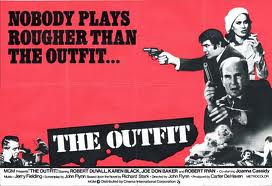
I've written previously about the Parker novels by Richard Stark on this blog (you can read the post here), and this early 1970s adaptation of the novel by the same name comes closest to capturing the flavour of Stark's writing. Point Blank is the best film made from a Parker novel, but it's not really true to the spirit of the books. And although The Outfit feels more like its source material, it still manages to miss the boat. It's entertaining, but there's some wonkiness that's hard to overlook.
The first oddity is that short, balding Robert Duvall is cast in the Parker role. Now Duvall can play tough, but he just doesn't appear tough (why does he hold his gun in that odd way?), and Parker is certainly described as looking rangy and menacing. The second oddity is that his character is called Earl Macklin instead of Parker. I can't even guess why that change was made. Joe Don Baker plays Macklin's sidekick and he would have been a much better choice for the Parker character.
The story is one that Stark would recycle in Butcher's Moon: the Outfit has killed Macklin's brother in retaliation for he and Earl having robbed a bank a few years previously that was controlled by the Outfit. Macklin goes to the Outfit's boss and demands a payment of 250k as a penalty for killing his brother (such brotherly love). The Outfit refuses, and Macklin and his sidekick begin knocking over Outfit properties until they agree to pay the "fine." They try to double-cross Macklin and that turns out to be a bad idea.
And now a word about the Outfit. The Outfit is a feature of the old Parker novels, and it's one that now feels somewhat dated. To a certain degree it plays the role that SPECTRE did in the James Bond novels. Both are highly organized criminal enterprises with interests in all kinds of criminal activity. The Outfit is essentially the Mafia, only it seems to be run entirely run by WASPy types. In Parker's world, every city has a parallel criminal economy, and it's all run by the Outfit.
The scenes of Macklin knocking over Outfit properties are done very well, and a lot of Stark's terse, muscular dialogue makes it to the screen to great effect. The acting is equally fine, which isn't surprising given that cast is stuffed with veteran character actors, everyone from Elisha Cook to Robert Ryan. Some parts are more uneven. Bruce Surtees is the cinematographer (he shot a lot Clint Eastwood's films) and he gives some scenes a nicely gritty look, but a lot of other scenes just look like a made-for-TV movie. Macklin's relationship with his girlfriend, played by Karen Black, is pointless and has an unpleasantly abusive aspect. The ending is the biggest disappointment. It feels hastily assembled and finishes on a jokey note that is very un-Parker.
The Outfit is worth watching, but I wouldn't go out of my way to track it down.
In 1962 Donald E. Westlake, writing as Richard Stark, introduced the character of Parker, a professional thief who is as remorseless as he is efficient. This first novel was The Hunter (filmed as Point Blank with Lee Marvin) and it probably marks the beginning of the modern American crime novel. Prior to The Hunter crime novels were largely about detectives and detection, and stories about criminals usually ended with the crooks caught or killed. Stark changed all that. Parker always lives to steal another day, and he usually leaves a high body count in his wake. And Parker's no Robin Hood; he steals for himself, and if his accomplices are caught or killed that's their bad luck. Parker isn't just hardboiled, he's frozen in carbonite.
One of the chief pleasures of the Parker novels is the plotting. The stories begin at a dead run and then rarely pause for a breath. Parker and his confederates always plan their heists to the last detail, but then something usually goes awry, and Parker ends up avoiding pursuers or doing some pursuing himself. Sometimes he's doing both at the same time. Despite the breathlessness of the plotting, Stark takes care to add some depth and shading to even minor characters, and he can also add humour here and there; in Butcher's Moon, in the middle of a casino heist, two thieves and the casino operator they're robbing suddenly have a ridiculously passionate discussion about health food and fitness.
It's easy to see the influence Stark had on Elmore Leonard, who began his crime writing career just as Stark was winding down the Parker series. Leonard's plots are also about criminal plots that go off the rails, his heroes are often Parker-like, and Leonard's novels always feature humorous, parenthetical moments. And Leonard in turn has influenced a host of other writers and filmmakers (step forward Mr Tarantino). The character of Parker has also been reborn in Lee Child's Jack Reacher thrillers. The Reacher character is definitely on the right side of the law, but his ruthlessness, his skill, his matter-of-fact approach to danger is pure Parker.
In Butcher's Moon, Parker and his frequent partner Alan Grofield travel to a small city in Ohio to reclaim a stash of money they'd hidden there years before. The money is missing and the finger of blame points towards the head of the local crime syndicate. Parker wants his money and applies pressure to the crime boss, but that ends with Grofield being wounded and captured. Parker then assembles a gang of thieves he's worked with in previous novels and they begin an all-out assault on the syndicate's men and businesses. Things get very exciting and very bloody.
Butcher's Moon, written in 1974, marks the end of "old" Parker. In 1999 Stark resumed writing Parker novels and these very definitely gave us a "new" Parker. New Parker is even better than old Parker. Old Parker novels occasionally suffer from stilted tough-guy dialogue, and the depiction of women can be summed up by the fact that they're usually referred to as "broads" or "dames." Also, the plots of some of the old Parkers sometimes bordered on the farfetched, straying out of the crime genre and into action/adventure. Butcher's Moon suffers a bit from this last problem, but in other respects it's a bridge to new Parker. The dialogue is free of cliche and there's no blatant sexism.
New Parker began with the aptly-titled Comeback, and in all respects Stark's writing is better. The plots are more unpredictable and believable, the dialogue is leaner and devoid of cliches, and Parker is made more human, but no less implacable and lethal, by the addition of a steady girlfriend. The best of the new Parkers is Breakout, which features both a prison escape and a heist. I suspect Stark brought back Parker because he felt a bit miffed that Leonard, Child, and others were getting rich in a genre that was largely his creation.
Check out the trailer for Point Blank below, but be warned that while it's superb, it makes significant departures from the book.
Oh, those arrogant, nervy French! Not only do they make a knock-off of The Silence of the Lambs, but they have the audacity to have one of the characters pull the Thomas Harris book from a shelf and give it a meaningful look. And then, to top it all off, they actually have the gall to make a better film.
Like The Silence of the Lambs, Chamber of Death is about a killer with a very pervy hobby, but it's also about a kidnapping scheme that goes horribly awry, a dark secret from the past, a petty crime that escalates into murder, and a love affair. In short, this film offers triple the plot of Silence, plus all the requisite tension, horror and drama.
Melanie Laurent, most well known for Inglorious Basterds, stars as Lucie, a detective and single mother of infant twins who's just recently joined the Dunkirk police. A young girl is found murdered and Lucie and her partner Pierre (Eric Caravaca) take the lead in the investigation. The girl appears to have been killed in a ritual manner, but the detectives soon find out that she was kidnapped for ransom. What they don't know is that the ransom payment was botched when two men on a late night drunken joyride struck and killed the girl's father, who was carrying two million Euros to a drop-off. The two men have the loot, but soon have a falling out. Another girl is kidnapped and Lucie and Pierre are racing against the clock to find her.
I won't try to describe all the twist and turns the plot takes, but the dense, twisty nature of the story is one of this film's main pleasures. The director, Alfred Lot, does an amazing job of juggling multiple storylines, and in the middle of this complicated cat-and-mouse thriller he manages to shoehorn in a sweet and believable romance between Lucie and Pierre. He also takes time to give some personality to even the most minor of characters.
The acting is uniformly excellent. Laurent is both appealing and believably tough. She's a bit like a French Sandra Bullock. Special mention goes to Gilles Lellouche who plays one of the men who steal the ransom money. His role is that of a decent man whose life takes one terrible turn, and Lellouche does an excellent job showing his horror and desperation. Lellouche is currently starring in Point Blank (my review here), which is an absolutely kick-ass thriller.
A lot of the credit for Chamber of Death has to go to Franck Thilliez, the co-scriptwriter and author of the novel the script is based on. Thilliez has written more than a few crime novels, but none of them, it seems, have been translated into English. If you go looking for this film take note that it's sometimes titled Melody's Smile. The trailer for the film that I've posted below is, unfortunately, in French only.