Showing posts with label The Son. Show all posts

Friday, August 12, 2022

Film Review: Prey (2022)


I've seen plenty of online comments which describe Prey as the best Predator film since the original. That's a very low bar to set, and this iteration doesn't clear it. And I so wanted to like it! Comanche vs Predator in the 18th century? Pump that ultra high concept shit right into my veins. The fact that Disney sent this straight to streaming was an admission on their part that it wasn't something they were happy with, and it's easy to see why. It's a naked and clumsy attempt to monetize old IP by cobbling together a hack script with some really cheap and cheesy CGI. 

It's a toss-up which is worse: the script or the visuals. Aside from a couple of establishing shots of glorious mountain scenery, the rest of the film doesn't look better or worse than any random episode of a show on the Outdoors Channel, and the CGI critters (there's lots of them) are astonishingly inept. Uncanny valley bad. CGI this weak effectively breaks the fourth wall and makes the audience either laugh or groan. More digital attention is paid to the Predator, but the problem there is that it's on screen too much. The original film rationed out its appearances to maximize the creature's shock value--the same principle that made Jaws work so brilliantly. In this outing the merciless alien is constantly seen on the hunt, which ups the body count (animal and human), but makes the Predator less visually impactful. And why no close-ups of its face?

The script's dull, boilerplate dialogue could be swapped out with any number of generic action films and it wouldn't make a bit of difference. The writers even recycle the "If it bleeds, we can kill it." line from the first film, although here it's delivered with all the panache of a fast food server reading back an order at a drive thru. What with all the hunting and killing, there's no time for characterization. Naru, the heroine, is the standard-issue aggrieved teenager who feels they're meant for bigger and better things but mum/dad/older sibling don't believe in them. Amber Midthunder plays Naru, and I'll be charitable and say that the script doesn't allow her to show whether she can act or not. 

The action sequences, which are bloody and frequent, are weakened by off-the-shelf fight choreography. When Naru takes on a gang of French trappers you could be forgiven if you think you're watching Captain America or Agent Romanov taking on baddies from the MCU. The slick, polished, tightly choreographed fight scenes of the Marvel world are the template here, and it's rather jarring when it's used in this setting. Something grittier and less obviously choreographed was needed. 

The film's PR machine has made much of how Prey has lots of Native American representation in front of the camera. True, but the creative team then made the decision have all the characters speak like contemporary teens and twentysomethings. Similar to corporate greenwashing, the film indulges in what could be called Indigenous-washing. The beliefs system, language structure, and moral code of the Comanche of 1719, were, needless to say, light years from our world, and the way they articulated their thoughts would have reflected this. By making them sound just like the average North American, the film denies their difference, takes away that uniqueness. It feels as though the producers were worried that a female lead fronting an all-Native American cast would alienate viewers, so they decided to sugarcoat the pill by having them sound like any random group of people hanging out in a suburban Starbucks. It doesn't have to be like this. Phillipp Meyer's western novel The Son (also an AMC mini-series) manages the tricky job of making the Comanche sound both profoundly different and contemporary. 

Although this new direction for the Predator franchise flops hard, it offers a glimmer of hope for further adventures. I'd love to see the big guy take on medieval knights, but the one I'm really hoping for is Predator vs Shaolin Monks done in full Golden Harvest style. Tarantino would come out of retirement for that one.

Saturday, September 12, 2015

Book Review: Blood Meridian (1985) by Cormac McCarthy

The first Cormac McCarthy novel I read was Cities of the Plain, and it's fair to say that I found it comprehensively bad. "But no!" people said. "That's the wrong one to start with. You should have read Blood Meridian!" There's a small group of writers I've read over the years that have elicited the same sort of response from friends and acquaintances. I tell someone I've read novel x by Ernest Hemingway/Graham Greene/Thomas Pynchon and not been impressed, and I'm then immediately told I read the wrong one--I should have read For Whom the Bell Tolls/Brighton Rock/Gravity's Rainbow. There seems to be a category of authors who are guaranteed to disappoint the reader unless you know how to tiptoe through his or her literary minefield.

Long story short, I gave McCarthy another chance. It was a qualified failure. Blood Meridian is widely regarded as his best novel, and is frequently mentioned as one of the great novels of modern American literature. I'll start with the good. Unlike Cities of the Plain and its dry, tone deaf prose, this novel features some superb descriptive writing. The novel follows a group of rapacious gunslingers called the Glanton gang on an odyssey through Texas, Mexico and the American Southwest as they hunt Apaches for a bounty on their scalps. McCarthy's descriptions of the land, the weather, and the hardscrabble towns the gang pass through are magnificent. His masterful way with metaphors and similes is astounding, and the novel can be enjoyed (partially) as an epic prose poem about the Old West.

Unfortunately, great description does not a novel make. It helps to have compelling characters, and McCarthy can't create characters if his life depended on it. All his cowboys comes from a big bin marked "Western extra type B: laconic." The Glanton crew are an undifferentiated mass of slow-talking cowpokes who sound as though they're in a western film rather than a western novel. The only exception is Judge Holden, who is given paragraph after paragraph of opaque, overripe, rambling dialogue about life and death and fate. It's pretty silly stuff, and feels like a misguided attempt to ape some of William Faulkner's characters, the ones who muse on existence and metaphysics while out on quail hunting trips. Holden is more symbol than man, and just in case the reader doesn't get this, McCarthy makes him exceedingly tall, completely hairless, white as a ghost, and exceptionally cruel. I'm surprised McCarthy stopped short of giving him a tattoo reading "Evil Incarnate." Holden is to be regarded, I'm guessing, as either a cruel god, a playful demon, or Death itself. He's so overdrawn, however, that he ends up in the same camp as cartoon horrors such as Freddy Kruger, Hannibal Lecter, and the better-quality Bond villains.

The plot is somewhere between thin and threadbare. The gang roams across the west killing just about every man, woman, child and animal they encounter. In-between massacres, atrocities and isolated killings, the boys get drunk, shoot up towns, and rob and rape. It's all a bit lather, rinse, repeat. If you were to stop reading it after about a hundred pages the only thing of interest you'd be missing is more prose poetry. The violence is unrelenting and, in the end, tedious. It doesn't add to our understanding of the barely-there characters, and the various bloody events read like scenes culled from McCarthy's favourite western films. In fact, one brief scene feels like a direct steal from The Good, the Bad and the Ugly.

The farther I got into Blood Meridian, the more I realized that Phillipp Meyer's 2013 novel The Son is a kind of rebuttal to McCarthy's book. Meyer's western novel tackles some of the same themes, even has an ultra-violent Holden-like character, but spreads itself over a much larger canvas with more imagination and skill, and, perhaps most strikingly, features native American and Mexican characters who aren't just cannon fodder for Yankee guns. And as it happens, I wouldn't recommend reading Meyer's first novel, American Rust (2009). It's the wrong one to start with.

Wednesday, April 22, 2015

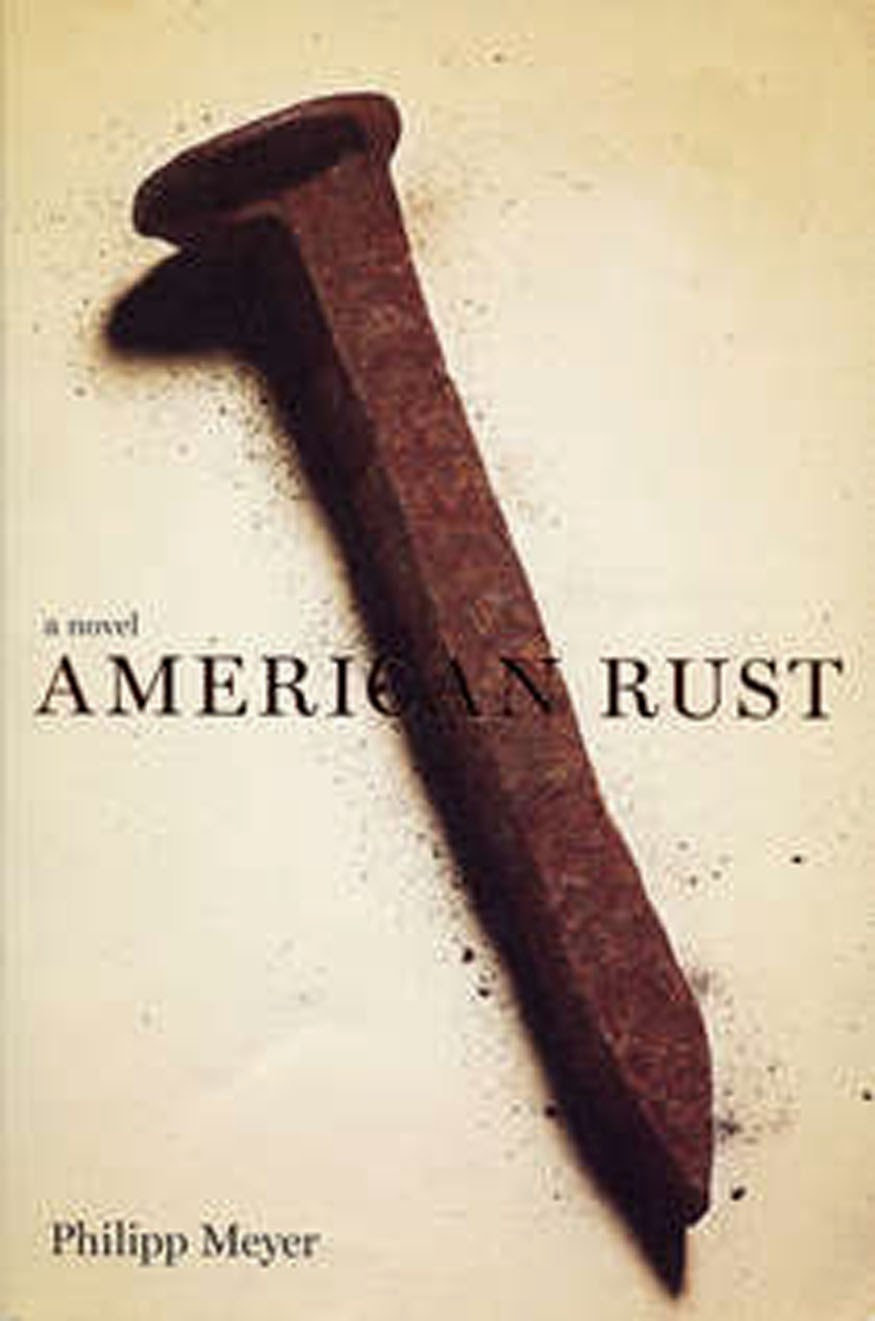
Book Review: American Rust (2009) by Philipp Meyer

This is Meyer's debut novel, and I'm so glad I read his second, The Son (my review), before this one. The Son is big, bold, self-assured and its few flaws are the result of too much ambition. American Rust reads like a novel created by a committee tasked with putting out a literary version of a multi-part New York Times piece on life in the Rust Belt. That Meyer is a good writer isn't in doubt; he writes sharp dialogue, his characters (the male ones, anyway) are rugged, edgy and painfully real, and his descriptions of landscapes, urban and natural, are superb. The problem here is that his novel doesn't have the ambition to be more than just a literary litany of what ails Pennsylvania's coal and steel towns.

The two central characters are Isaac and Billy, best friends, both barely out of their teens, and both unsure what to do with their lives. They live in Buell, PA, and like every other town in the region it's been economically devastated by the death of the US steel industry. Those who aren't unemployed are working for minimum wage or are living a semi-criminal life. Isaac steals some money from his crippled father and decides to hit the road to California by hopping freight trains. Billy, an ex-high school football star, opts to accompany him for no better reason than it seems like a good idea at the time. They are an unlikely pair; Isaac is a weedy brainiac and Billy is a jock with a penchant for violence. They've barely started on their journey when they have an altercation with three homeless men that ends with Isaac accidentally killing one of them by way of defending Billy. A few days later Billy is arrested and charged with the murder, which he doesn't deny in an act of self-sacrifice to give some meaning to his selfish and wasted life. Isaac, meanwhile, goes on the run. Isaac's and Billy's fractured families are drawn into the story, but it's at this point that the story runs aground. The novel is told from the POV of a half dozen or so characters, but what's missing is a compelling narrative. Once Billy's arrested the story drags its feet as we hear from the different characters and their stories of despair and struggle in the heart of the Rust Belt. The only tension or narrative momentum is provided by Billy's stint in jail as he awaits trial and faces the wrath of prison gangs. The writing in this section is excellent, but it could just as well have been dropped in from a standard crime fiction novel.

American Rust is brimming with sympathy for its beaten-down characters and the region that's become an industrial dust bowl. What's missing from this story, what makes the novel so frustrating, is that Meyer shies away from bringing politics into the story. The plight of people in the Rust Belt is entirely the result of a series of ruinous political and economic decisions made by politicians and corporate executives stretching back decades. Meyer barely hints at the factors that impoverished this region. It's akin to writing a novel set in Vichy France and not mentioning the war or the Nazis. The virtually apolitical outlook of the novel isn't unusual in American literature. European writers, especially in the crime fiction field, enthusiastically bring politics and big business into their stories. American writers can't seem to get past their nation's religious belief that the individual and the individualism is everything. They don't seem happy with the idea that a character can be a hopeless victim or puppet of forces beyond his control. Or perhaps they feel that the nuts and bolts of politics and high finance don't have a place in literature. Nineteenth century writers such as Zola, Balzac, and Trollope happily took on these subjects, but the only American of that ilk that comes to mind is Gore Vidal.

Meyer's novel ticks all the boxes when it comes to mentioning issues like drug abuse, unemployment, underemployment, municipal underfunding, poor healthcare, and so on, but without giving these issues any historical or sociological context, Meyer is doing a disservice to the very people he so clearly sympathizes with. The people in the Rust Belt know they've been victimized by politicians and big business, but in American Rust this catastrophe is almost presented as a natural disaster, something that happened for no rhyme or reason.

The committee feel to the novel comes from the inclusion of far too many stock characters and tropes from modern literary fiction. There's the suicide of a mother that damages the children; the Ivy League woman who can't resist the manly charms of Billy the jock; the embittered father, broken in body and mind; and the young, tortured genius who's just too sensitive for this world. And does anyone actually ride the rails these days? Last of all, it has to be said that Meyer is poaching on literary territory created and mastered by K.C. Constantine (my piece on hiin is here), who wrote a series of crime novels set in Pennsylvania's coal and steel country. Constantine, however, was not afraid to bring politics into the mix.

Thursday, March 6, 2014

Book Review: The Son (2013) by Phillipp Meyer

A lot of the reviews of The Son have labeled it as The Great American Novel. I won't give The Son that award, but it's definitely a great American novel. It's tempting to call it The Great American Novel because Meyer has taken a hard look at his country through the prism of Texas' history and decided that America's past, when reduced to its ugly essentials, is a story of rapacious colonization and the ruthless exploitation of labour and natural resources, with the wheels of both processes greased by violence and racism. The history of Texas provides plenty of examples to prove Meyer's thesis.

The Son is the story of the McCullough family, from their arrival in Texas as settlers in the 1830s right up to their eventual status as oil barons in 2012. The story is told through the voices of three different generations of McCulloughs: Eli, Peter and Jeanne. Eli is the founder of the family fortune. Captured by Comanches at the age of thirteen, he eventually bonds completely with his captors and becomes a warrior, happily taking white scalps along with his fellow braves. The Comanche, along with other Indian tribes, succumb to disease and white expansion, and Eli rejoins the white world and becomes a Texas Ranger. The grubstake Eli uses to make his fortune comes courtesy of his armed, and bloody, robbery of a Union supply column carrying gold. Soon after that he begins acquiring land in west Texas. Peter, Eli's son, is born in 1870 and his section of the saga covers the years 1915-17, during which the Texas Border Wars with Mexico are raging. Eli is still alive at this time (he lives to the ripe age of 100) and uses the wars as a pretext for slaughtering his neighbors, the Garcias, and stealing their land through a legal subterfuge. Peter is appalled by his father's actions and the moral character of his peers and state, and eventually makes a complete break with his family by disappearing into Mexico. Jeanne is born in 1926 and completes the family's transition (begun by Eli) from land and cattle to oil.

The Eli section of the novel is one of the great western stories in American literature, albeit one that probably owes a debt of inspiration to Thomas Berger's Little Big Man. Eli's story is exuberantly raw, bloody, violent and cruel. You could call this America in its proto-capitalist phase, when all you needed to do to get ahead of the other guy was to kill him and steal all his belongings, as well as slaughtering his family. Eli is the "son" of the novel's title. He's cursed with being a product of two patriarchal cultures. From his Comanche side he gets a high tolerance for the suffering of others and a fierce sense of tribal loyalty. From the American side he gets a burning desire to own and possess everything, and from both influences he receives lessons in the utility and pleasures of violence.

Peter is the first in the family's history to realize that their clan and caste are a curse upon the land. His tragedy is that his moral viewpoint isn't backed up by a high enough degree of moral courage. Peter makes an attempt to prevent his father massacring the Garcias, but, by his own reckoning, he doesn't do enough and finds he can't live with the guilt until an opportunity comes to redeem himself. Peter is the most complex character in the novel, and if it sometimes feels like Peter has wandered in from a William Faulkner novel, that's intended as a compliment to Meyer because parts of the novel are the equal of Faulkner.

The Jeanne section of the novel is the weakest of the three. It feels like Meyer just isn't sure what to do with this character or the story and ends up, well, faffing about a bit. Eli started his fortune entirely through violence, while the events of 1915 in Peter's part of the story shows the McCulloughs expanding their wealth through a combination of violence and legal trickery, and I think Meyer wanted to show how, over time, American capitalism was able to engage in thievery without the use of violence. At one point we learn that Jeanne has profited enormously from the savings and loan crisis of the 1980s, and there are hints she's involved in shady dealings in the Middle East, but this idea isn't fully developed. Instead, the story flits around without settling on a theme or central issue, and the climax, which involves a distant, and unknown, Mexican relative feels contrived.

Even with some bumps along the way, The Son is always compulsively readable. Like Texas, Meyer's writing is big and bold, but at the same time he can deftly and poetically describe the beauty of western landscapes or the intricate details of daily life in a Comanche camp. Parts of this novel are very raw and cruel, but this fits into the author's goal of showing the savage roots of American expansionism. I should walk that last statement back a bit and point out that Meyer also argues that violence and ruthless acquisitiveness are part of the human condition. Meyer does this by not sugarcoating his Comanche characters with any kind of  "noble savage" nonsense. They, like the invading whites, have a taste for theft and violence, and as several Comanche characters point out, long before the whites arrived the indigenous peoples were enthusiastically slaughtering each other. This isn't the Great American Novel, but if you paired it with Charles Portis' Masters of Atlantis (my review) you'd have the yin and yang of America, or perhaps what could be called the Great American Reading Experience.