The one and only reason Hollywood buys up the remake rights to foreign films such as L'appartement, The Departed, Cell 211, Lake Mungo and this one is that they all have rock solid scripts. These are films that start with clever, original concepts and carry through with polished, smart scriptwriting. Hollywood is, in effect, buying the blueprints for success. This begs the eternal question of why filmmakers outside the U.S. seem to be so much better at coming up with original ideas for films. The answer is money.
In lieu of creativity Hollywood has money. A film such as Cowboys & Aliens uses pricey stars, expensive sfx, and wall-to-wall advertising to put bums in seats. And all that money couldn't buy a concept that was as good as most old Star Trek episodes. It's as though the studio was trying to bribe the audience to come to the cinema. Elsewhere, however, filmmakers can't sell sizzle, they have to sell steak. That means coming up with a concept and script that's so compelling it stands out from the background noise of the Hollywood hype machine. A Spanish or French filmmaker can't go to local production company with a weak idea and say that the final film will succeed if only they fork over north of $100m on stars and marketing. It's not going to happen. They need a concept that works no matter how low the budget.
And this brings me to Point Blank, a nearly flawless French thriller that wastes not a second of screen time. Without going spoiler-crazy I'll just say that it's about a hospital orderly played by Gilles Lellouche (previously seen in Chamber of Death) who is forced to remove an injured criminal from the hospital he works in. Things go badly wrong, of course, and the balance of the film's lean 84-minute running time is spent in chases, fights, hairbreadth escapes and the unraveling of a conspiracy and a coverup. In other words, everything you want in a thriller, only without big stars, over-the-top (and expensive) action sequences, and a saturation ad campaign that gives away all the best bits.
Gilles Lellouche is excellent as the orderly who finds himself running for his life. The script doesn't have him be unbelievably resourceful or tough, just desperate and determined. Roschdy Zem, France's go-to tough guy actor, plays the injured and hunted criminal and he brings a lot of presence to the role. The only problem I have with the film is the title. Why confuse your film with a 1960s classic? That's the only unoriginal idea in the whole film.
Monday, January 16, 2012
Friday, January 13, 2012
Book Review: The 9/11 Wars (2011) by Jason Burke
Well, it's all here in one volume: the sad history of the various wars, insurgencies, riots, rebellions and terrorist campaigns that followed or stemmed from the attack on the World Trade Center towers. Jason Burke, a correspondent for the Guardian, gets full marks for a detailed and nuanced history of a fiendishly complicated subject. This is a history that covers events in Europe and America, as well as throughout the Islamic world, and the roll call of individuals, organizations, and groups is a long one.
Burke is at his best when he picks apart the 2003 invasion of Iraq and its bloody aftermath. He shows that the U.S. decision to invade and occupy Iraq with a minimal number of troops was a boneheaded decision that doomed the country to years of terrorism and sectarian warfare. Equally tragic were the American decisions to disband the Iraqi Army and remove Ba'ath Party members from government. Those two actions instantly created a huge pool of angry, impoverished Iraqis who were happy to take up arms against the invaders.
This book also makes it clear that al-Qaeda, as a terrorist group, is more of a concept than an actual organization. Islamic militants in places as far apart as Morocco and Indonesia come together and form al-Qaeda groups, as opposed to recruiters from al-Qaeda travelling the world setting up terror cells. Basically, many militants use the al-Qaeda title to indicate their purpose and goals, rather than an actual affiliation to a governing body.
The saddest aspect of Burke's history is that he reveals the futility of hoping for any kind of truly democratic governments to take root in places like Iraq, Afghanistan and Pakistan. In all three countries tribal, clan, village and family loyalties and obligations take precedence over any kind of political organization. And a great many conservative Muslims, according to their interpretation of the Koran, view even the idea of government as anathema.
The only minor quibble I have is that Burke doesn't talk enough about the price Iraqi civilians have paid for the war. He says that up to 165,000 Iraqis were killed as a direct result of the invasion and its aftermath, but he doesn't detail the many more deaths, especially of children, that have occurred as result of Iraq's basic infrastructure falling apart. Disease, malnutrition, and contaminated water have probably killed as many Iraqis as have the bullets and bombs.
Burke is at his best when he picks apart the 2003 invasion of Iraq and its bloody aftermath. He shows that the U.S. decision to invade and occupy Iraq with a minimal number of troops was a boneheaded decision that doomed the country to years of terrorism and sectarian warfare. Equally tragic were the American decisions to disband the Iraqi Army and remove Ba'ath Party members from government. Those two actions instantly created a huge pool of angry, impoverished Iraqis who were happy to take up arms against the invaders.
This book also makes it clear that al-Qaeda, as a terrorist group, is more of a concept than an actual organization. Islamic militants in places as far apart as Morocco and Indonesia come together and form al-Qaeda groups, as opposed to recruiters from al-Qaeda travelling the world setting up terror cells. Basically, many militants use the al-Qaeda title to indicate their purpose and goals, rather than an actual affiliation to a governing body.
The saddest aspect of Burke's history is that he reveals the futility of hoping for any kind of truly democratic governments to take root in places like Iraq, Afghanistan and Pakistan. In all three countries tribal, clan, village and family loyalties and obligations take precedence over any kind of political organization. And a great many conservative Muslims, according to their interpretation of the Koran, view even the idea of government as anathema.
The only minor quibble I have is that Burke doesn't talk enough about the price Iraqi civilians have paid for the war. He says that up to 165,000 Iraqis were killed as a direct result of the invasion and its aftermath, but he doesn't detail the many more deaths, especially of children, that have occurred as result of Iraq's basic infrastructure falling apart. Disease, malnutrition, and contaminated water have probably killed as many Iraqis as have the bullets and bombs.
Thursday, January 12, 2012
Film Review: Detective Dee and the Mystery of the Phantom Flame (2011)
Martial arts films used to be cheap and cheerful affairs. All you needed in terms of sets were a tavern with lots of breakable furniture, a couple of kung fu schools with nicely proportioned courtyards suitable for mass brawls, and a few streets filled with hawkers standing behind easily upsettable carts and stalls. Add in some stroppy and arrogant kung fu masters, an evil warlord, and a recent graduate of Shaolin Temple and you were good to go. Not anymore.
Kung fu films have become Asia's answer to Hollywood's toga epics of the 1950s and '60s. Today's martial arts film features thousands of extras, elaborate costumes, and lots and lots of CGI to recreate China through the ages. Crouching Tiger, Hidden Dragon can be credited with starting the trend, and since then we've had Legend of the Black Scorpion, House of Flying Daggers, Musa the Warrior, Seven Swords, The Warlords and a whole bunch more of the same.
Detective Dee has the costumes, extras and CGI, but it also doubles down on the craziness. Dee is some kind of martial arts wizard/judge/detective who's tasked with finding out why important court officials are suddenly bursting into flame. It looks like magic but it isn't. Dee learns that there's a plot afoot to kill the Dowager Empress Wu, who is poised to become China's first female emperor. Dee saves the day and solves the mystery after battling all manner of kung fu baddies. Along the way he visits an underground city to fight a semi-mechanical man; takes on a herd of ninja deer; and generally defies the laws of gravity and physics as he kicks all kinds of ass.
A fair number of kung fu films from the '70s featured this kind of zaniness, the best being Master of the Flying Guillotine, which, as titles go, is a 100% accurate description of the contents therein. It also featured a Hindu kung fu warrior with extendable arms. I'm serious. The point being that Detective Dee has a lot of the same silliness but now it's being done with a budget in the millions. It's quite enjoyable even if it can't quite match the lunacy of Flying Guillotine. Both trailers are below for comparison purposes.
Kung fu films have become Asia's answer to Hollywood's toga epics of the 1950s and '60s. Today's martial arts film features thousands of extras, elaborate costumes, and lots and lots of CGI to recreate China through the ages. Crouching Tiger, Hidden Dragon can be credited with starting the trend, and since then we've had Legend of the Black Scorpion, House of Flying Daggers, Musa the Warrior, Seven Swords, The Warlords and a whole bunch more of the same.
Detective Dee has the costumes, extras and CGI, but it also doubles down on the craziness. Dee is some kind of martial arts wizard/judge/detective who's tasked with finding out why important court officials are suddenly bursting into flame. It looks like magic but it isn't. Dee learns that there's a plot afoot to kill the Dowager Empress Wu, who is poised to become China's first female emperor. Dee saves the day and solves the mystery after battling all manner of kung fu baddies. Along the way he visits an underground city to fight a semi-mechanical man; takes on a herd of ninja deer; and generally defies the laws of gravity and physics as he kicks all kinds of ass.
A fair number of kung fu films from the '70s featured this kind of zaniness, the best being Master of the Flying Guillotine, which, as titles go, is a 100% accurate description of the contents therein. It also featured a Hindu kung fu warrior with extendable arms. I'm serious. The point being that Detective Dee has a lot of the same silliness but now it's being done with a budget in the millions. It's quite enjoyable even if it can't quite match the lunacy of Flying Guillotine. Both trailers are below for comparison purposes.
Wednesday, January 11, 2012
Film Review: Red Sun (1971)
I have a high tolerance for Euro-schlock films of the 1970s, the kind that feature multinational casts in thriller/western/cop movies with a B-movie sensibility. These films weren't always cheaply made, and there was usually some A-list talent in the cast. Red Sun is a good example of this type of film. It's a western, shot, of course, in Spain, and features a United Nations of stars: Charles Bronson, Toshiro Mifune, Alain Delon and Ursula Andress. Let's see, that's respectively an American, a Japanese, a Frenchman and a Swiss sex symbol. Bronson is the only one in the movie with an accent matching the film's setting. In 1971 all four of these actors were major stars.
The story has train robber Bronson double-crossed by Delon, who also steals a ceremonial sword in the care of Mifune. Bronson and Mifune, playing a samurai, team up to find Delon. Basically it's a lightly comic road movie with Bronson initially mocking Mifune's strange ways, but then realizing he's a "hell of a man." Along the way they fight some bandits, slaughter some Comanche, and enjoy some gratuitous nudity courtesy of Ursula Andress. The actors seem to enjoy themselves, and this film probably marks one of the last occasions on which Charles Bronson actually did some acting. Once he transitioned from Europe to the U.S.A. he became the Easter Island statue of actors.
The action scenes are fairly plentiful, albeit perfunctory, which is a bit surprising considering that Terence Young, director of three of the early Bond films, was in charge of things. The most dated part of the film is its treatment of Indians. By this stage in Hollywood Indians were the beneficiaries of revisionist history and were presented in a sympathetic light, or at least weren't treated as devils in buckskins. In Europe, however, Indians were still just colourful villains. In Red Sun the Comanche are whooping, incompetent cannon fodder for Bronson's gun and Mifune's sword. And they wear the worst native outfits I have ever seen in a western; they look like leftover Hallowe'en costumes from K-mart. So if you're hopelessly addicted to westerns or Euro-schlock or both, check it out.
The story has train robber Bronson double-crossed by Delon, who also steals a ceremonial sword in the care of Mifune. Bronson and Mifune, playing a samurai, team up to find Delon. Basically it's a lightly comic road movie with Bronson initially mocking Mifune's strange ways, but then realizing he's a "hell of a man." Along the way they fight some bandits, slaughter some Comanche, and enjoy some gratuitous nudity courtesy of Ursula Andress. The actors seem to enjoy themselves, and this film probably marks one of the last occasions on which Charles Bronson actually did some acting. Once he transitioned from Europe to the U.S.A. he became the Easter Island statue of actors.
The action scenes are fairly plentiful, albeit perfunctory, which is a bit surprising considering that Terence Young, director of three of the early Bond films, was in charge of things. The most dated part of the film is its treatment of Indians. By this stage in Hollywood Indians were the beneficiaries of revisionist history and were presented in a sympathetic light, or at least weren't treated as devils in buckskins. In Europe, however, Indians were still just colourful villains. In Red Sun the Comanche are whooping, incompetent cannon fodder for Bronson's gun and Mifune's sword. And they wear the worst native outfits I have ever seen in a western; they look like leftover Hallowe'en costumes from K-mart. So if you're hopelessly addicted to westerns or Euro-schlock or both, check it out.
Sunday, January 8, 2012
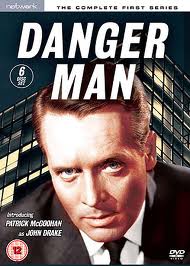
TV Review: Danger Man
Most people are familiar with Patrick McGoohan as number 6, the title character from The Prisoner. Before that series he became a star in Danger Man (called Secret Agent in the U.S.), a British TV series that ran intermittently from 1960-68. I recently got the whole series on DVD and have been pleasantly surprised at how it stands up.
Danger Man is a spy show, with John Drake (McGoohan) travelling the globe (as created on English sound stages) to catch double agents, moles, and so on. There are several factors that keep the shows entertaining even after nearly fifty years. The first is McGoohan. He's a compelling actor with an often eccentric way of delivering lines, and he's not above hamming it up, especially when he's called upon to play "roles" while undercover. In one episode he's a very proper butler, and in another he's garrulous playboy. McGoohan does both roles with a great deal of relish.
The series is also well-written and takes a realistic, non-James Bond look at spies and spying. In fact, some episodes, notably one set in the Middle East called Fish on the Hook, feel like something John Le Carre might have written. Spying is shown to be ruthless and, on occasions, a morally dubious activity.
One thing that's largely absent from the series is sex and romance. Spy shows and movies in the '60s were as much about babes as they were microfilm and thwarting the Red Menace. Evidently McGoohan insisted on a chaste spy show (he was a staunch Catholic) and this actually works to the show's advantage. Shows such as The Saint and the The Man From U.N.C.L.E. had to devote a lot of their plot time to getting their leads involved with an interchangeable series of curvy females. It was all rather juvenile and repetitive. Because Danger Man didn't have to waste time this way, more effort is put into plotting and characterization.
Not every episode is a gem. One titled The Paper Chase is directed by McGoohan and it doesn't add anything to his CV. It moves slowly and has a number of self-indulgent directorial flourishes. All in all, Danger Man is still worth watching unless you're adamant that TV spies must come equipped with female eye candy. The clip below shows the opening credits.
Danger Man is a spy show, with John Drake (McGoohan) travelling the globe (as created on English sound stages) to catch double agents, moles, and so on. There are several factors that keep the shows entertaining even after nearly fifty years. The first is McGoohan. He's a compelling actor with an often eccentric way of delivering lines, and he's not above hamming it up, especially when he's called upon to play "roles" while undercover. In one episode he's a very proper butler, and in another he's garrulous playboy. McGoohan does both roles with a great deal of relish.
The series is also well-written and takes a realistic, non-James Bond look at spies and spying. In fact, some episodes, notably one set in the Middle East called Fish on the Hook, feel like something John Le Carre might have written. Spying is shown to be ruthless and, on occasions, a morally dubious activity.
One thing that's largely absent from the series is sex and romance. Spy shows and movies in the '60s were as much about babes as they were microfilm and thwarting the Red Menace. Evidently McGoohan insisted on a chaste spy show (he was a staunch Catholic) and this actually works to the show's advantage. Shows such as The Saint and the The Man From U.N.C.L.E. had to devote a lot of their plot time to getting their leads involved with an interchangeable series of curvy females. It was all rather juvenile and repetitive. Because Danger Man didn't have to waste time this way, more effort is put into plotting and characterization.
Not every episode is a gem. One titled The Paper Chase is directed by McGoohan and it doesn't add anything to his CV. It moves slowly and has a number of self-indulgent directorial flourishes. All in all, Danger Man is still worth watching unless you're adamant that TV spies must come equipped with female eye candy. The clip below shows the opening credits.
Wednesday, January 4, 2012
Book Review: Johannes Cabal, the Detective (2010) by Jonathan L. Howard
Saying that this is a steampunk novel is an almost useless definition. So many literary mash-ups fly the flag of steampunk that it should be a requirement that they come with flowcharts that explain the various influences and homages that make them up. In this case we have a story set in a mostly alternate reality Europe in which the usual eastern European countries are replaced by states called Mirkarvia, Senza, and Katamenia. The time period is, roughly speaking, Edwardian, and the technology features airships (of course) and entomopters, a dragonfly-inspired aircraft. The literary influences include Agatha Christie, H.P. Lovecraft, and boys adventure magazines like Chums. In sum, the usual DNA of a steampunk adventure.
What sets Cabal apart from the common herd of blood and thunder Victoriana steampunk fiction is that Howard clearly set out with a strong story idea before adding in the steampunk elements. And it doesn't hurt that he's a fine writer. Johannes Cabal, the Detective is the second in a series and it manages to mix together a locked room mystery with a spy action-thriller as well as a taste of supernatural horror. It's to Howard's credit that none of these elements feel forced or awkward. Other steampunk writers I've read tend to clutter up the foreground with steampunk set dressing, as it were, and leave the story behind. This novel would work well even if it wasn't set in an alternate historical reality. Really, the steampunk stuff is just a bonus.
This adventure finds Cabal, a necromancer, fleeing Mirkarvia after raising the country's king from the dead (temporarily). He flees to Senza aboard an airship under a false name and then the fun begins. One of the passengers is murdered and Cabal reluctantly takes the case. Much action and intrigue ensues, and the finale features a spectacular airship crash. As action-y as the story is, it's first and foremost a comic novel, with a comic style influenced heavily by Blackadder. Like Blackadder, Cabal is self-centred, vicious, and mostly concerned with saving his own skin. He does have a glimmer of humanity, and it's brought out by Leonie Barrow, his sidekick in this adventure who, I'm guessing, was introduced in the previous book.
There aren't many writers who can mix comedy and adventure this well, and Howard is definitely one of them. He even manages to provide a clever epilogue to the story that works beautifully as a standalone tale of supernatural horror. My only reservation about the novel is that Cabal's resolute nihilism might make him less interesting to follow in successive stories. But I'll take that chance.
What sets Cabal apart from the common herd of blood and thunder Victoriana steampunk fiction is that Howard clearly set out with a strong story idea before adding in the steampunk elements. And it doesn't hurt that he's a fine writer. Johannes Cabal, the Detective is the second in a series and it manages to mix together a locked room mystery with a spy action-thriller as well as a taste of supernatural horror. It's to Howard's credit that none of these elements feel forced or awkward. Other steampunk writers I've read tend to clutter up the foreground with steampunk set dressing, as it were, and leave the story behind. This novel would work well even if it wasn't set in an alternate historical reality. Really, the steampunk stuff is just a bonus.
This adventure finds Cabal, a necromancer, fleeing Mirkarvia after raising the country's king from the dead (temporarily). He flees to Senza aboard an airship under a false name and then the fun begins. One of the passengers is murdered and Cabal reluctantly takes the case. Much action and intrigue ensues, and the finale features a spectacular airship crash. As action-y as the story is, it's first and foremost a comic novel, with a comic style influenced heavily by Blackadder. Like Blackadder, Cabal is self-centred, vicious, and mostly concerned with saving his own skin. He does have a glimmer of humanity, and it's brought out by Leonie Barrow, his sidekick in this adventure who, I'm guessing, was introduced in the previous book.
There aren't many writers who can mix comedy and adventure this well, and Howard is definitely one of them. He even manages to provide a clever epilogue to the story that works beautifully as a standalone tale of supernatural horror. My only reservation about the novel is that Cabal's resolute nihilism might make him less interesting to follow in successive stories. But I'll take that chance.
Monday, January 2, 2012
Film Review: Champagne for Caesar (1950)

This comedy is interesting for a couple of reasons. The first is that it was one of Hollywood's first films about the growing popularity and power of TV. The Milady soap company is the sponsor of a TV quiz show that gives contestants the chance to keep doubling their money, starting at $5, just by answering questions in their declared field of expertise. If they get a question wrong they lose everything. It's a lame but popular show until one Beauregard Bottomly (Ronald Colman), a snob and polymath, decides to put the show off the air by refusing to bow out after winning a respectable amount of money. Bottomly wants to own the company. The owner of Milady, Burnbridge Waters (Vincent Price), cancels the show, but slumping sales force him to put Bottomly back on the air even as he's poised to win $40m and the whole company.
Champagne clearly sides with Bottomly's view that TV marks the decline of Western civilization. The host of the quiz show is a bantering idiot played by Art Linkletter, and Vincent Price's Waters character is a crazed capitalist with the emphasis on crazed. What the film gets dead right is that the viewing public can become transfixed and emotionally-committed to utterly trivial individuals as long as they're on TV.
That Champagne succeeds as a comedy is largely thanks to Vincent Price. After seeing his performance you really have to wonder if he wasn't wasted in horror movies. Price acts the buffoon better than he ever acted the villain. Balancing out Price's performance in a negative sense is Art Linkletter, who really was a radio and TV celebrity of the kind being mocked. Linkletter clearly knows nothing about acting and his line readings are so off the mark you'd almost think English was his second language. The rest of cast is good, and the script has more than its share of good comic moments, but it's Vincent Price who makes this film worth watching.
Subscribe to:
Posts (Atom)